

Cyber Risk Management: The Essential Guide to Protecting Your Business Before the Attack
Cyber threats are no longer a distant possibility. They are a challenge for organizations of every size. Attackers target weak passwords, outdated software, exposed cloud services, human mistakes, and gaps in third party security. However, no business can fix every weakness at once. Cyber risk management offers a smarter path. It helps leaders identify high impact threats, prioritize safeguards, and improve security over time. In the guide, you will learn what cyber risk management is, why it matters, and how to build a process to protect your business before an incident occurs.
What is Cyber Risk Management?
Cyber risk management is the continuous process of identifying, assessing, treating, and monitoring risks linked to technology and information. It includes cybersecurity controls, governance, employee awareness, third party risk, backups, incident response, and business continuity.
This approach is different from treating compliance as the finish line. Compliance is important, but a certificate or policy does not automatically protect a business. Effective risk management connects security decisions to real business priorities. For example, a manufacturer may focus on production continuity, while a healthcare organization may place greater emphasis on patient data and access control.
Cyber risks can come from many sources and common examples include:
⦁ Malware and ransomware
⦁ Phishing and social engineering
⦁ Stolen credentials
⦁ Weak access controls
⦁ Unpatched software
⦁ Cloud misconfigurations
⦁ Insider misuse
⦁ Third party security weaknesses
⦁ Insecure applications and APIs
⦁ Service outages
⦁ Poor backup practices
Why Cyber Risk Management Matters
Cybersecurity is no longer only an IT concern. A serious attack can affect revenue, customers, employees, operations, and reputation. It can also create legal and regulatory problems. A structured cyber risk management program helps businesses prepare before these problems occur.
Prevent avoidable attacks
Many successful attacks begin with known weaknesses, such as unpatched applications, reused passwords, excessive permissions, and poorly secured remote access. A structured risk process helps security teams rank these issues by likelihood and impact, then fix the most dangerous ones first.
Protect revenue and operations
An incident can stop employees from working, interrupt customer services, delay payments, or shut down an online store. Recovery may involve investigation, restoration, legal advice, customer support, and lost business. Risk management defines response roles, communication channels, backups, and recovery steps before an emergency occurs.
Build trust and support compliance
Customers expect businesses to protect personal and financial information. Clear policies, responsible data handling, strong access controls, and tested response plans demonstrate that security is part of everyday operations.
Many organizations also face requirements related to privacy, payment data, health information, or industry security. A mature risk program creates evidence that risks are being identified, assigned, treated, and reviewed.
Cyber Risk Management Frameworks
A framework gives an organization a practical structure for managing cyber risk. It does not replace judgment, but it prevents important activities from being forgotten.
The NIST Cybersecurity Framework is a flexible option for organizations of different sizes and sectors. It organizes cybersecurity work around understanding assets and risks, protecting important resources, detecting suspicious activity, responding to incidents, and recovering operations.
The ISO/IEC 27001 provides a formal information security management system. It can help organizations establish governance, policies, risk assessments, controls, and continual improvement.
The CIS Critical Security Controls provide prioritized technical and operational safeguards. They are useful for organizations that want a practical starting point, especially when resources are limited.
Other frameworks and standards may apply to specific needs.
⦁ COBIT focuses on technology governance and management.
⦁ HITRUST is commonly used in healthcare environments.
⦁ FAIR helps organizations analyze information risk in financial terms.
⦁ PCI DSS focuses on payment card security.
⦁ GDPR and other privacy laws affect how businesses collect, use, store, and protect personal information.
The best choice depends on your industry, size, customers, regulations, and risk tolerance. A framework should make your program clearer, not create unnecessary paperwork.
The Cyber Risk Management Cycle
The process below provides a practical model for organizations of different sizes. It is a continuous cycle, not a one time checklist.
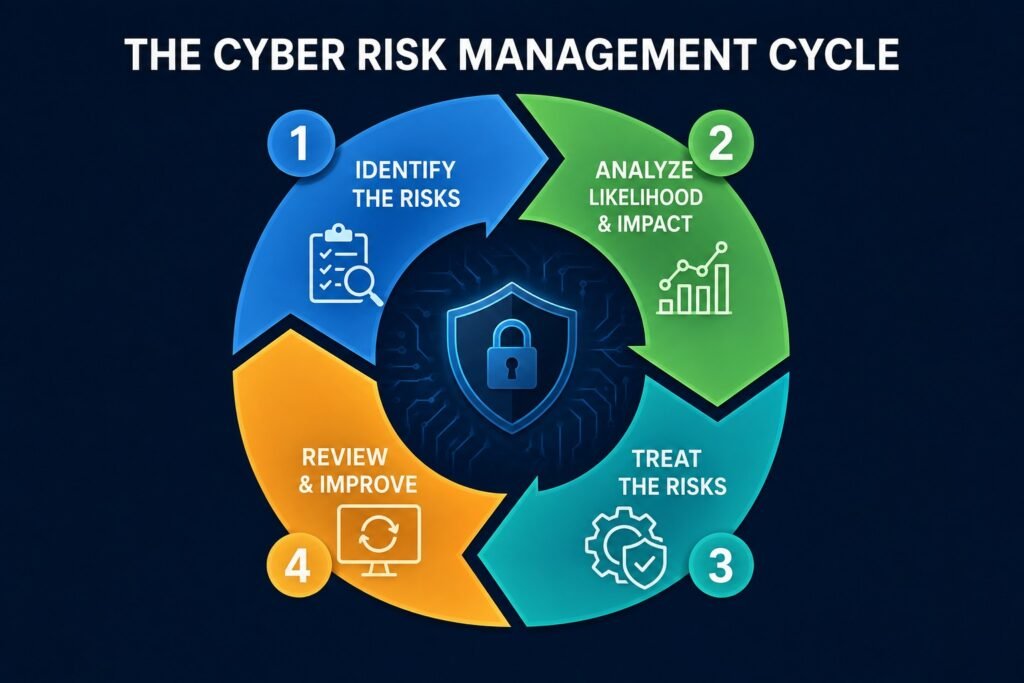
Step 1: Identify risks
Create an inventory of laptops, servers, applications, databases, cloud services, websites, mobile devices, connected systems, and third party platforms.
Then consider phishing, ransomware, malware, credential theft, insider activity, supply-chain attacks, data loss, power outages, and natural disasters. Useful activities include vulnerability scanning, penetration testing, risk workshops, supplier reviews, cloud configuration checks, and employee feedback.
Step 2: Analyze likelihood and impact
Assess how likely each event is and what could happen if it occurs. Consider financial loss, downtime, legal exposure, reputational damage, customer impact, and safety concerns. A simple risk matrix helps teams compare risks consistently. More mature programs may use quantitative analysis to estimate loss ranges.
Step 3: Treat the risks
Choose one of four common treatments:
⦁ Reduce: Add controls such as MFA, encryption, segmentation, patching, or staff training.
⦁ Avoid: Stop using a service or process that creates unacceptable exposure.
⦁ Transfer: Share some financial responsibility through contracts, suppliers, or cyber insurance. Transfer does not remove the underlying risk.
⦁ Accept: Formally acknowledge a risk when it falls within the organization’s tolerance.
Every treatment decision should have an owner, deadline, and success measure.
Step 4: Monitor and improve
New vulnerabilities appear, employees change roles, vendors update systems, and attackers develop new techniques. Monitor security alerts, privileged accounts, unusual activity, vulnerability trends, backup results, training completion, and supplier changes. Test incident response and recovery procedures regularly, then record what must improve.
A Practical Risk Priority Table
The table below shows how a small organization might turn common exposures into prioritized actions. The ratings are examples only. Your scores should reflect your own environment.
| Risk Area | Example Exposure | Priority | First Action |
|---|---|---|---|
| Identity and access | Shared accounts or missing MFA | Very High | Remove shared accounts and enforce strong authentication |
| Unpatched software | Unsupported systems or delayed updates | High | Create an asset inventory and set patch deadlines |
| Phishing and human error | Suspicious links or accidental data sharing | High | Provide security awareness training |
| Cloud misconfiguration | Public storage or excessive permissions | Medium-High | Review configurations and apply least privilege |
| Third party exposure | Supplier access without security checks | Medium | Assess vendors and limit external access |
| Backup and recovery | Untested or poorly protected backups | Medium | Protect backups and test restoration |
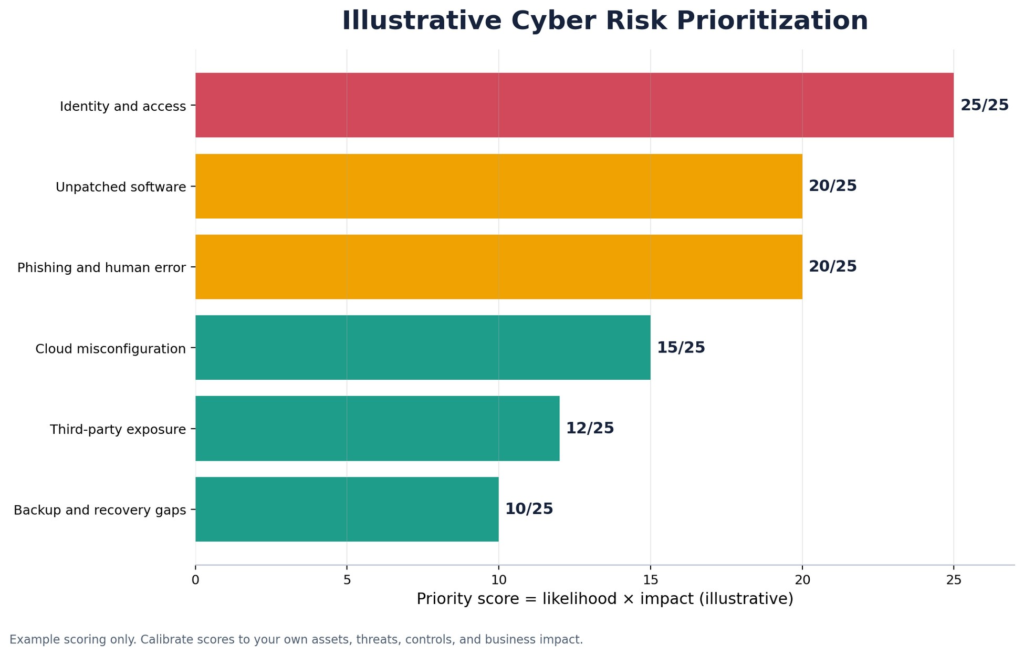
Chart: Illustrative priority scores based on likelihood multiplied by impact. The values are not industry statistics.
Benefits and Best Practices for SMBs
A strong risk management program offers several tangible benefits beyond just stopping breaches:
⦁ Increased Operational Efficiency: Identifying vulnerabilities early reduces “firefighting” emergencies.
⦁ Lower Insurance Costs: Many insurers reward businesses that can demonstrate proactive security measures with lower premiums.
⦁ Enhanced Customer Trust: Being known as a secure partner is a powerful marketing advantage.
Focus on these high impact areas to improve resilience today:
⦁ Prioritize Assets: Allocate the largest share of your budget to your most critical data.
⦁ Enable Multi Factor Authentication (MFA): This is the single most effective step to prevent unauthorized access.
⦁ Patching Routine: Update software within days of a security release to close known exploits.
⦁ Backup Regularly: Use the 3-2-1 rule: three copies, two different media types, and one copy kept entirely offline.
⦁ Train Employees: Conduct short, regular training sessions on spotting phishing and social engineering attempts.
Common Challenges and Improving Resilience
Small and mid sized businesses often struggle with limited budgets and high complexity. The solution is not to ignore the problem but to use a risk based approach to spend wisely. Partnering with a specialized firm like Axelris can provide the expertise you need without the cost of a full time in house team.
Furthermore, managing “Shadow IT” unauthorized apps and devices is a growing challenge. Clear policies and employee engagement are key to bringing these hidden risks into the light. The goal is resilience: the ability of an organization to withstand an attack, maintain critical functions, and recover quickly. You are not just protecting servers by building a disciplined framework. You are protecting the livelihoods of your employees and the trust of your customers.
A Practical 90 Day Action Plan
You do not need to change your entire security program in one week. A simple 90 day plan can help you make steady progress.
Days 1–30: Build Visibility
⦁ Choose an executive sponsor and a risk owner.
⦁ List your critical systems, apps, data, users, suppliers, and internet-facing services.
⦁ Make sure administrator accounts use strong authentication.
⦁ Record the most serious security weaknesses.
⦁ Find any old or unsupported technology.
Days 31–60: Reduce Key Risks
⦁ Patch or isolate the most exposed systems.
⦁ Remove unnecessary accounts and permissions.
⦁ Protect your backups.
⦁ Improve email and endpoint security.
⦁ Give employees short security awareness training.
⦁ Create an incident contact list.
⦁ Decide who can approve emergency actions.
Days 61–90: Test and Improve
⦁ Run a tabletop incident response exercise.
⦁ Test whether backups can be restored.
⦁ Review supplier access.
⦁ Track progress with a simple security dashboard.
⦁ Report serious unresolved risks to leadership.
⦁ Assign an owner and target date for each major risk.
⦁ Review and update the plan every quarter.
Cyber risk management is an ongoing process. Review your risks regularly and update your security plan whenever your business changes.
How Axelris Can Help
A practical cyber risk program needs both strategy and execution. Axelris Technologies supports organizations with cybersecurity strategy development, risk assessment, penetration testing, cybersecurity audits, managed detection and response, and related security services.
The right support can help you understand your exposure, identify hidden weaknesses, improve visibility, and build a response capability that fits your environment. The goal is not to purchase more tools. It is to make better security decisions, reduce meaningful risk, and create resilience that supports business growth.
Ib Knudsen, Founder & CEO of Axelris Technologies, emphasizes the strategic nature of this challenge:
“Cyber risk management is no longer simply about protecting technology. It is about protecting the business itself. Organizations that understand their cyber risks, anticipate emerging threats, and take proactive action are better positioned to protect their people, their data, their reputation, and their future.” — Ib Knudsen, Founder & CEO, Axelris Technologies.
Conclusion
Cyber risk management is not a one time project. It is a business discipline that connects people, processes, technology, and leadership. You can reduce disruption and recover faster by identifying critical assets, prioritizing realistic threats, treating high impact risks, and testing your response. The goal is not perfect security. It is informed and measurable resilience. Start with the risks that matter most, improve steadily, and make security part of everyday decisions. A proactive approach today can protect your customers, revenue, and reputation, and safeguard your future tomorrow and beyond.
© 2026 Axelris Technologies International, Inc. All rights reserved.