
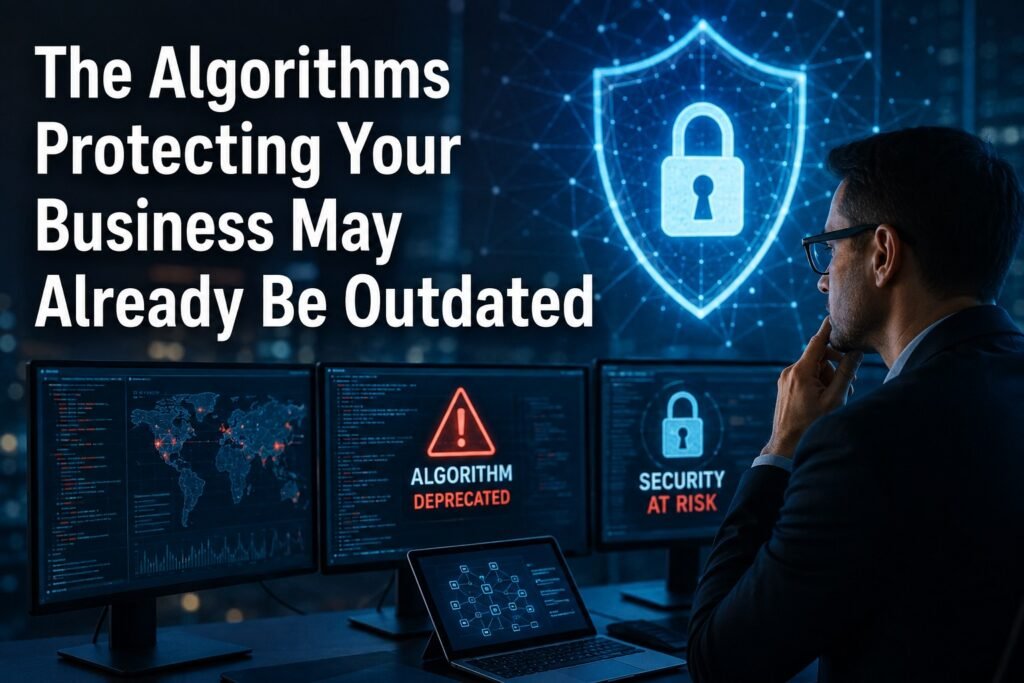
The Algorithms Protecting Your Business May Already Be Outdated
“Cybersecurity isn’t just about buying better tools. It’s about ensuring the mathematics behind those tools still deserves your trust. The algorithms protecting your business today won’t protect it forever, and leaders who understand that will be far better prepared for tomorrow’s threats.” — Ib Knudsen, CEO, Axelris Technologies, Inc.
Most modern executives perceive cybersecurity as a collection of physical and digital assets: robust firewalls, sophisticated endpoint monitoring, and comprehensive awareness programs. However, beneath this technological layer resides a silent, mathematical architecture: the algorithm. These models encrypt data, authenticate identities, and detect threats. However, mathematics is not a static shield. As computing power grows and adversaries innovate, algorithms that were once industry standards can quietly become significant liabilities. For leadership teams, the critical question is no longer just “Are we protected?” but rather, “Are the mathematical algorithms protecting our business still fit for purpose?”
The Invisible Foundation: Why Algorithms Decay
In physics, we measure the stability of elements by their half-life. In modern cybersecurity, we must adopt the concept of the “cryptographic half-life.” The efficacy of any security algorithm is relative, contingent entirely upon the computational force available to compromise it. This is not merely a technical nuance; it is a fundamental business risk. While “vulnerabilities” typically refer to bugs in software code, an algorithmic vulnerability represents a flaw in the underlying logic. Once the math is broken, every tool reliant upon it becomes fundamentally compromised.
Cryptographic Algorithms: The Shield that Rusts
Cryptography serves as the silent guardian of customer records and financial transactions. But these guards suffer from institutional fatigue. Consider the history of cryptographic hashing. A hash functions as a digital fingerprint, ensuring data integrity.
Reflect on the legacy of MD5 and SHA-1. Once the industry standard, this approach was eventually shown to have “collision” vulnerabilities, where two distinct files could produce the same hash. Organizations that failed to migrate to SHA-2 or SHA-3 left their digital “fingerprints” open to forgery while wasting millions on secondary defenses. We see this today with RSA-1024; what was robust a decade ago is now trivial for a determined adversary with sufficient server capacity to crack.
Resilient encryption is not a one-time deployment but a perpetual habit. This is “cryptographic agility,” the organizational capacity to swap obsolete mathematical models for modern ones without disrupting operations. If your infrastructure is “hard-coded” to a single algorithm, you are operating on borrowed time.
Detection Algorithms: The Brains of the Operation
If cryptography conceals your data, detection algorithms expose your enemies. Modern Managed Detection and Response (MDR) platforms utilize two primary methodologies, functioning like a combination of a physical lock and a sophisticated motion sensor:
⦁ Signature-Based Detection: This identifies “known-bad” code with high precision. It is effectively a blacklist of known offenders. While excellent for legacy threats, it is blind to novel exploits.
⦁ Behavioral Analytics: Powered by AI, this proactively identifies anomalies. It does not look for a specific file. It monitors for “intent.” If a server begins exfiltrating data to an unverified destination at 3:00 AM, the algorithm flags the behavior regardless of whether the attacker used valid credentials.
The contemporary challenge is that adversaries use these same AI tools to automate attacks, generating thousands of malware variants per second. We are now engaged in a war of Algorithms-vs-Algorithms. To prevail, your detection logic must possess higher velocity and greater “intelligence” than the attacker’s math.
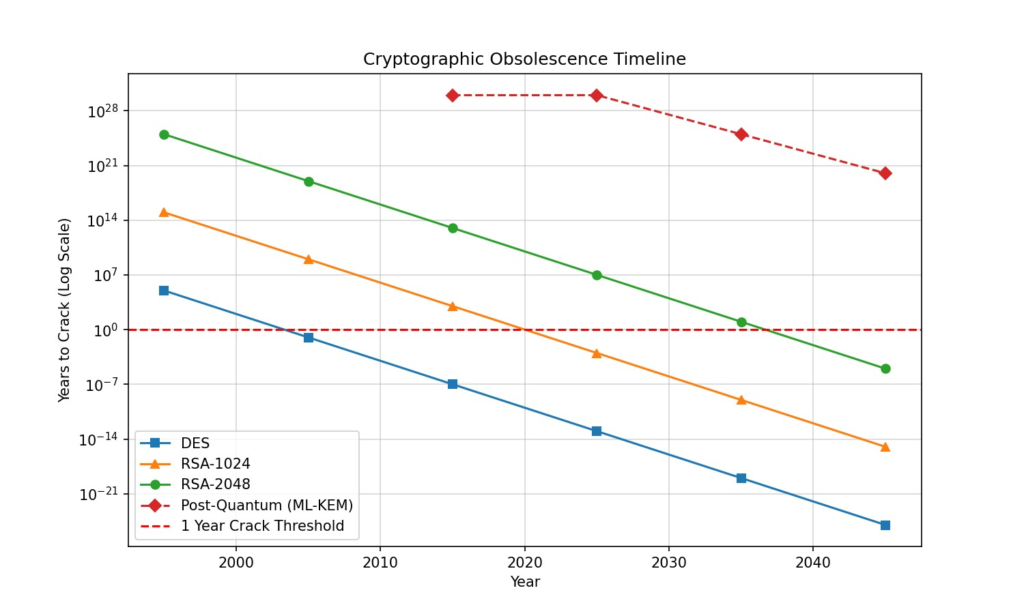
Figure 1: The decay of trust over time as compute power (Moore’s Law) and Quantum Computing erode traditional cryptographic standards.
The Quantum Horizon: Preparing for “Q-Day”
One of the biggest risks facing boards today is the “Quantum Horizon.” A sufficiently powerful quantum computer could theoretically break nearly all current public-key encryption schemes, undermining the complex mathematical problems that safeguard global banking and healthcare. Experts refer to this inevitable milestone as “Q-Day,” the moment current encryption becomes functionally obsolete.
Harvest Now, Decrypt Later
State-sponsored actors and sophisticated syndicates are currently engaged in “Harvest Now, Decrypt Later” strategies. They intercept and store your encrypted data today, anticipating the arrival of quantum capabilities to unlock it in the future. If your data requires a secrecy lifespan of ten years such as trade secrets or long-term health records, you are already at risk. Data stolen in 2026 may be fully transparent by 2030.
The New NIST Standards for 2026
In response to this threat, the National Institute of Standards and Technology (NIST) finalized the Post-Quantum Cryptography (PQC) standards in August 2024. These standards were the result of global collaboration to find math problems that remain “hard” even for quantum computers. The primary winners include:
⦁ FIPS 203 (ML-KEM) (formerly Kyber): Optimized for general data protection and secure key exchange.
⦁ FIPS 204 (ML-DSA) (formerly Dilithium): Designed for digital signatures and identity verification.
⦁ FIPS 205 (SLH-DSA): An alternative digital signature standard for high-security environments.
Business leaders should review their technology systems and ask their vendors, “What is your plan for adopting post-quantum cryptography (PQC)?” If a vendor lacks a clear roadmap for migrating to ML-KEM and other NIST-approved standards, their security solution could become outdated in the near future.
Case Study: The Cost of Algorithmic Neglect
Consider a mid-sized financial firm. They spent $5 million on new firewalls. They had the latest hardware. But they kept using an old encryption standard for their internal chat. They thought it was “internal,” so it didn’t matter. A hacker gained access to their network through a simple email scam. Once inside, they could not break the firewall to get data out. But they could “listen” to the internal chat.
The hacker used an automated tool to break the old chat encryption. It took them less than three minutes. They found the CEO’s login details in a chat message. With those details, they could bypass every other security tool. The firm lost $20 million in a single weekend. This was not a hardware failure. It was a failure in mathematics. They trusted an algorithm that had already been outgrown by the hacker’s tools.
The C-Suite Strategy: Moving from Tools to Trust
Governance of cybersecurity must move from the server room to the boardroom. Risk management now requires a shift from purchasing “security products” to investing in “security intelligence.” This necessitates a recalibration of how we evaluate technology partnerships.
A Comparative Analysis of Algorithmic Lifecycles
Category Legacy (Avoid) Current (Safe) Future (Ready)
Hashing MD5, SHA-1 SHA-256, SHA-3 Specialized PQC
Encryption RSA-1024 RSA-2048, ECC ML-KEM (Kyber)
Signatures DSA EdDSA, ECDSA ML-DSA (Dilithium)
Detection Static Rules AI Anomaly Detection Autonomous AI Agents
The “Algorithm-First” Vendor Audit
When evaluating new digital investments, executives should demand answers to four specific queries:
⦁ Model Refresh Frequency: How often are your threat detection models updated and retrained? Models updated annually are insufficient for modern threat cycles.
⦁ SHA-3 Adoption: Does the platform support modern hashing standards?
⦁ PQC Roadmap: What is the specific plan for integrating NIST-approved quantum-resistant math?
⦁ Operational Agility: Can the system rotate encryption standards without requiring a total rebuild?
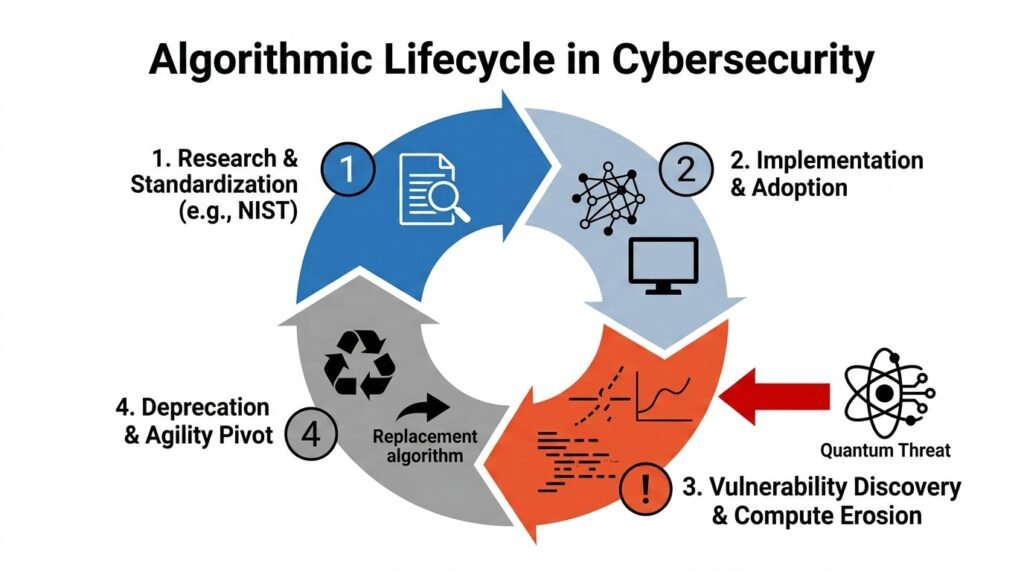
Figure 2: The cycle of research, adoption, and change required to stay safe.
Regulatory Pressure and Compliance
Regulators are placing greater emphasis on modern cybersecurity practices. Frameworks such as the European Union’s NIS2 Directive and the Digital Operational Resilience Act (DORA) encourage organizations to implement state-of-the-art security measures and continuously manage cyber risks.
Using outdated cryptographic standards may not only increase the likelihood of a successful cyberattack but could also expose organizations to regulatory
penalties, legal challenges, and reputational damage.
Compliance is no longer simply about checking boxes. Organizations are expected to demonstrate that they regularly review their security controls, replace outdated technologies, and adopt stronger encryption standards as industry best practices evolve. For executive leaders, maintaining modern cryptography is becoming both a security requirement and a governance responsibility.
The Anatomy of an Algorithmic Pivot
Moving to new algorithms is hard. It is like changing a plane’s engine while it is flying. But it is necessary. A good plan has three clear steps:
⦁ Phase 1: Inventory. List every place you use encryption. This includes your cloud apps, your local servers, and your backups.
⦁ Phase 2: Testing. Try new PQC tools in a safe spot. See how they affect your system speed.
⦁ Phase 3: Rollout. Update your most important systems first. Start with the data that must remain secret the longest.
AI-Driven Threats: The New Reality
One growing concern is adversarial machine learning, where attackers make small changes to malicious software so it appears harmless to conventional detection systems. Although the malware still performs the same harmful actions, basic security tools may classify it as safe. To keep pace with these evolving threats, organizations need intelligent detection systems that analyze behavior rather than relying solely on known malware signatures.
The Role of Behavioral Analytics
Old tools looked for a “bad file.” New tools look for “bad behavior.” This is a huge shift. For example, imagine a user who usually works from London. Suddenly, they log in from Tokyo. Then, they start downloading 10,000 sensitive files. A good algorithm will see this. It doesn’t care if the user has the right password. It seems the behavior is wrong. This is how you win the war of the algorithms. You use math to find patterns that a human would miss.
The Cultural Shift: Mathematics as a Core Value
For a long time, we thought of security as a “cost.” It was something we had to pay for. Now, we must see it as a “value.” The math you choose reflects how much you value your customers. It shows that you respect their privacy. It tells them you are a leader who looks forward.
When you sit in the boardroom, don’t ask about the “brand” of the firewall. Ask about the “version” of the encryption. Ask if your team is testing for quantum threats. This is how you protect your business for the next ten years, not just the next ten months. Trust is the currency of the digital age. And that trust is built on a foundation of mathematics.
Strategic Implementation Roadmap for 2026
Organizations can begin preparing for the post-quantum era with a structured roadmap:
⦁ Q1: The Audit. Review all third-party software. Find out what algorithms they use.
⦁ Q2: The Pilot. Start a small project using ML-KEM. Learn how it works.
⦁ Q3: The Training. Teach your security team about PQC. They need to understand the new math.
⦁ Q4: The Update. Change your official security policy. Make PQC the new standard for all new projects.
Conclusion
Cybersecurity resilience is not determined by the size of your budget, but by the integrity of your mathematical foundations. As we move into an era defined by AI-driven threats and quantum possibilities, the “set it and forget it” mentality is a path to obsolescence. Organizations that prioritize algorithmic hygiene and cryptographic agility will do more than just survive. They will maintain the most valuable asset in the digital economy: stakeholder trust. In the world of cybersecurity, yesterday’s mathematics rarely provides tomorrow’s protection. Choose your algorithms as carefully as you choose your partners.
© 2026 Axelris Technologies, Inc. All rights reserved.