

Why Businesses Are Turning to Managed Cybersecurity Service: Cost, Compliance, and Confidence
In the hyper connected economy of 2026, cybersecurity has transitioned from a technical “back office” requirement to a fundamental pillar of corporate strategy. The surface area for potential attacks has expanded exponentially as organizations integrate agentic AI, automated supply chains, and real time data lakes. For modern leaders, the question is no longer whether to invest in security, but how to do so in a way that fuels growth rather than draining resources.
This shift has led to the rise of Managed Security Service Providers (MSSPs). Today, businesses are turning to managed solutions not just for protection, but as a strategic lever for competitive advantage. Organizations are securing their future in a hostile digital landscape by focusing on three critical domains: Cost, Compliance, and Confidence.
Pillar 1: The Economic Imperative (Transforming Cost into Value)
The financial impact of a cyberattack is the single greatest threat to enterprise value for many growing companies. Research indicates that a data breach in 2026 costs organizations an average of $4.88 million. However, the true “burn rate” is often seen in downtime.
The Real Cost of Downtime
Downtime in 2026 is no longer just a server being offline. It represents the complete paralysis of an organization’s digital nervous system. For a mid-
size business, the average cost of downtime is now estimated at $14,000 per minute. When systems go dark, revenue leakage, idled labor costs, and missed Service Level Agreements (SLAs) create a staggering financial bleed.
Managed cybersecurity services address this by shifting security from a high CapEx “building” model to a predictable OpEx “subscription” model. Instead of investing millions in a proprietary Security Operations Center (SOC) and the “Elite 1%” of talent, businesses can “rent” world class expertise at a fraction of the cost. This talent arbitrage is critical. With a global shortage of over 4 million cybersecurity professionals, hiring in house is not just expensive. It is often impossible.
| Strategic Dimension | In House Build Out (DIY) | Managed Security Service (MSSP) |
|---|---|---|
| Talent Acquisition | High difficulty; 4M+ talent shortage. | Immediate access to specialized, elite teams. |
| Technology Stack | Heavy CapEx; risk of rapid obsolescence. | OpEx model; continuous “state of the art” tech. |
| Threat Intelligence | Limited to internal network visibility. | Global visibility across multi industry datasets. |
| Availability | Often limited to business hours (8/5). | Guaranteed 24/7/365 proactive monitoring. |
| Scalability | Slow; requires months of hiring/training. | Immediate; scales with business growth. |
Pillar 2: The Compliance Maze (Navigating Regulatory Complexity)
As digital operations grow, so does the regulatory burden. In 2026, compliance is no longer a “check the box” annual activity. It is a real time requirement. The legal landscape is more complex than ever, with the Digital Operational Resilience Act (DORA) and NIS2 alongside established standards like GDPR, CCPA, and HIPAA.
The 2026 Regulatory Landscape: DORA and NIS2
The Digital Operational Resilience Act (DORA) has changed how financial entities and their third party service providers manage risk. Similarly, NIS2 has expanded its reach to include “essential” and “important” entities across dozens of sectors. These laws don’t just demand security. They demand resilience. They require organizations to prove they can withstand, respond to, and recover from all types of ICT related disruptions.
Managed service providers act as a “Compliance as a Service” partner. For example, they provide the required documentation, ongoing control monitoring, and reporting systems that make audits a smooth part of daily operations rather than a stressful yearly event. For growing companies in the USA expanding into European markets, having an MSSP that understands these global frameworks is a mandatory prerequisite for growth.
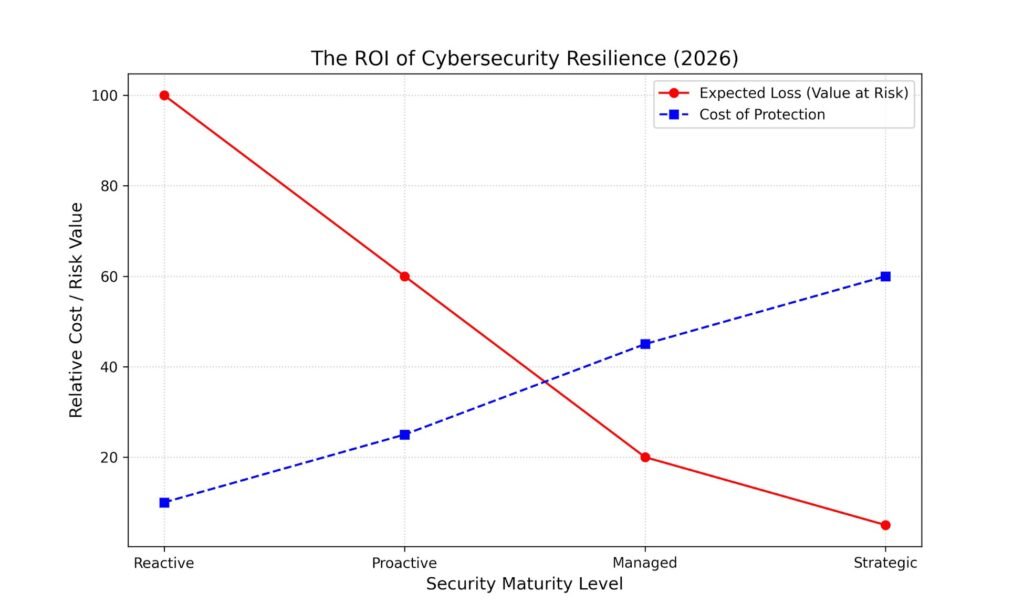
Note: Our analysis shows that as organizations move from “Reactive” to “Managed” status, the expected loss (Value at Risk) drops precipitously. At the same time, the cost of protection stays significantly lower than the potential loss.
Beyond the Compliance Floor
While these frameworks set a “compliance floor,” true market leaders aim for strategic excellence. Managed services provide the specialized knowledge required to anticipate future regulations rather than reacting to them.
This proactive stance leads to:
⦁ Reduced Regulatory Risk: Avoiding fines that can reach 4% of annual global revenue.
⦁ Faster Contract Wins: Security audits are now mandatory in B2B sectors. A mature security posture allows companies to skip these hurdles.
⦁ Enhanced Capital Access: Investors increasingly use cybersecurity maturity as a key metric for ESG (Environmental, Social, and Governance) scores
Pillar 3: The Confidence Dividend (Fueling Growth with Certainty)
Confidence is the intangible but essential result of a professional security posture. When leaders know their “crown jewels” are protected by 24/7 monitoring and AI driven threat intelligence, they can focus on innovation rather than firefighting.
The Rise of Automated Adversaries
The primary threat is no longer the “lone hacker” but highly organized, AI powered syndicates. Attackers are now using “Adversarial AI” to conduct reconnaissance on an unprecedented scale. They can scan millions of networks for a specific, newly discovered vulnerability in minutes. This speed of attack makes manual, human led defense impossible.
Managed Cybersecurity provides the AI driven countermeasures necessary to fight fire with fire. MSSPs can contain threats in seconds, long before they can escalate into a full scale breach, by using automated detection and response. This technological superiority provides the “peace of mind” that allows boards to approve ambitious digital transformations.
The Quote that Defines Modern Security
As Ib Knudsen, CEO of Axelris Technologies, recently stated:
“Businesses today need cybersecurity that delivers certainty. Managed security services provide the expertise, compliance readiness, and cost efficiency that modern organizations require, allowing leaders to focus on growth with confidence rather than worrying about emerging threats.”
This sentiment underscores why Professional Cybersecurity is a board level perspective. It turns security from a “speed brake” into an accelerator. Just as a race car has world class brakes so it can go faster, a business has world class security so it can adopt emerging technologies like Generative AI and Cloud native architectures with total confidence.
The Managed Security Ecosystem
Managed services create a “Digital Trust Dividend.” In an era where 45% of organizations identify cyberattacks as their most significant operational threat, being a “trusted” brand is a massive competitive differentiator. According to McKinsey research, consumers are increasingly likely to switch brands after a security incident. Conversely, a “Professional” cybersecurity posture turns security into a brand promise.
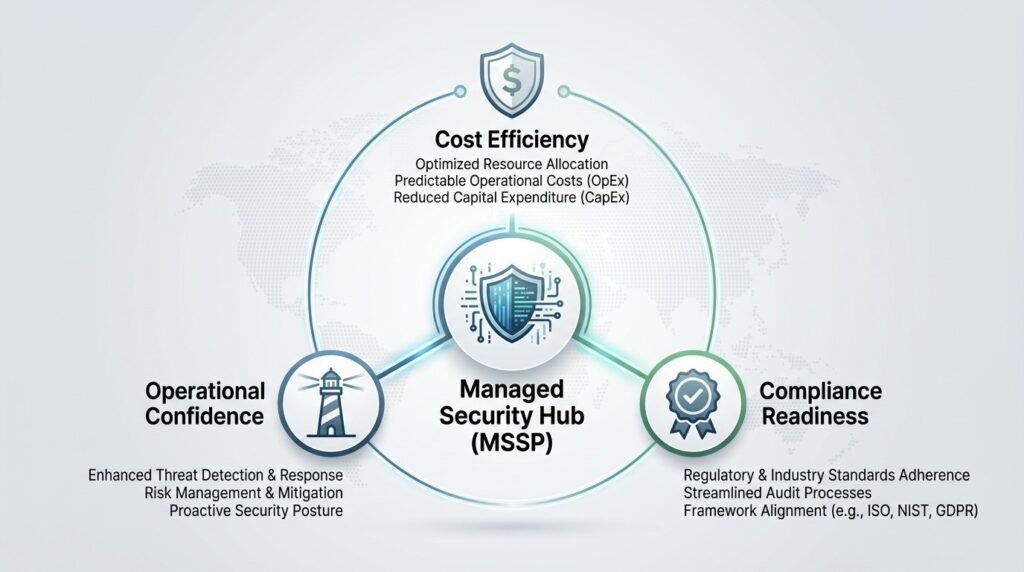
The illustration depicts the MSSP as a central hub providing 24/7 threat intelligence, vulnerability management, and incident response, supporting the three pillars of Cost, Compliance, and Confidence.
Why Managed Services are No Longer Optional
For years, many businesses relied on a “generalist” IT model, hiring one person to handle everything. However, in 2026, managed IT services are no longer optional. The complexity of modern IT, including endpoint management, identity and access management, cloud administration, and disaster recovery, requires a depth of specialization that no single individual can provide.
The Resilience Dividend: Strategic Differentiation
Building a competitive advantage with professional cybersecurity means moving beyond defense. Instead, it means leveraging trust and digital integrity as market winning assets. Organizations that treat security as a “sunk cost” are often hamstrung by legacy vulnerabilities. By contrast, those with a managed, agile security framework can launch new products and pivot points without re-engineering their entire stack. As a result, this “Time to Market” advantage is directly attributable to the scalability of a managed partnership.
The Human Element and Operational Structure
Interestingly, 95% of cybersecurity incidents are still caused by human error. Managed service providers mitigate this risk through automated controls and continuous employee training. Additionally, they move the organization from “tribal knowledge” held by one or two people to a structured, documented, and resilient system. In essence, businesses are buying a system, people, process, and tools designed to deliver proactive monitoring and standardized configurations.
Conclusion: Securing the Foundation for Future Success
The transition to managed cybersecurity services is a recognition that digital risk is now the primary business risk. In the landscape of 2026, operational continuity has transitioned from a technical requirement to a boardroom imperative. Companies are doing more than just “locking the doors” by turning to experts for their security needs. They are building a foundation for sustainable growth, protecting their brand reputation, and ensuring they can navigate the complexities of a hostile digital world.
Organizations that take a proactive, managed approach today will lead their industries tomorrow. Managed IT and cybersecurity are not simply alternatives to internal hiring. They are growth enablers that transfer technology risk from the business to specialists equipped to handle it. In the words of Axelris leadership, “Operational continuity is a competitive advantage. Downtime is what happens when it’s left unprotected.”
FAQs
- What is the difference between Managed IT and Managed Cybersecurity?
Managed IT focuses on the functionality and availability of your systems (help desk, cloud management, uptime). Managed Cybersecurity (MSSP) focuses on protecting systems from threats, ensuring compliance (such as GDPR/NIS2), and providing rapid incident response. - Is Managed Cybersecurity affordable for small businesses?
Yes. Managed services use a subscription based OpEx model. As a result, they provide enterprise level security tools and “Elite 1%” talent at a fraction of the cost of building an in-house Security Operations Center. - How does Managed Cybersecurity help with global compliance like NIS2 or DORA?
MSSPs provide automated reporting, continuous control monitoring, and the technical documentation required by these frameworks. Therefore, they ensure that compliance is a real time state rather than an annual project. - Why is downtime so expensive in 2026?
The “surface area of failure” has expanded as businesses integrate AI and real time data. A single hour of downtime now averages over $300,000 for mid sized firms when factoring in idle labor, lost revenue, and recovery friction.
© 2026 Axelris Technologies, Inc. All rights reserved.