

Prevent Fraud: Everyone in Your Organization Should Know This
The modern workplace is more connected, digital, and efficient than ever before. While these advancements have transformed the way organizations operate, they have also created new opportunities for cybercriminals. Today’s fraud is no longer limited to fake invoices or stolen credit cards. It has evolved into a sophisticated global industry powered by artificial intelligence, social engineering, and highly convincing impersonation techniques.
The risks increase as organizations enter the busy summer vacation period. Offices often work with reduced staffing levels. Managers may be away, and normal approval processes may be disrupted. Fraudsters know this and deliberately target businesses when employees are under pressure and verification procedures are more likely to be overlooked. This guide explains today’s most common fraud threats, why they succeed, and the practical steps every employee can take to protect both themselves and the organization.
“Fraud is no longer just a financial risk. It is a business risk that can impact your trust, reputation, and operations. As fraudsters become more sophisticated, organizations must strengthen not only their technology but also their employees’ awareness. The most effective defense is a culture where people feel empowered to pause, verify, and question unusual requests.” — Ib Knudsen, CEO, Axelris Technologies
The Sophistication of Modern Fraud
We are living in an era where “Fake Bosses,” “Fake Employees,” and “Fake Invoices” are not just headlines. They are daily threats powered by generative AI and social engineering. Fraudsters are now using deepfake audio to mimic a CEO’s voice in an urgent phone call or creating pixel perfect replicas of vendor invoices that bypass traditional filters.
According to recent global data, the impact is staggering. Organizations worldwide are losing an average of 7.7% of their annual revenue to fraud. In the United States, that figure rises to nearly 10%. This is not just “missing money”. It is a drain on innovation, employee bonuses, and company growth.
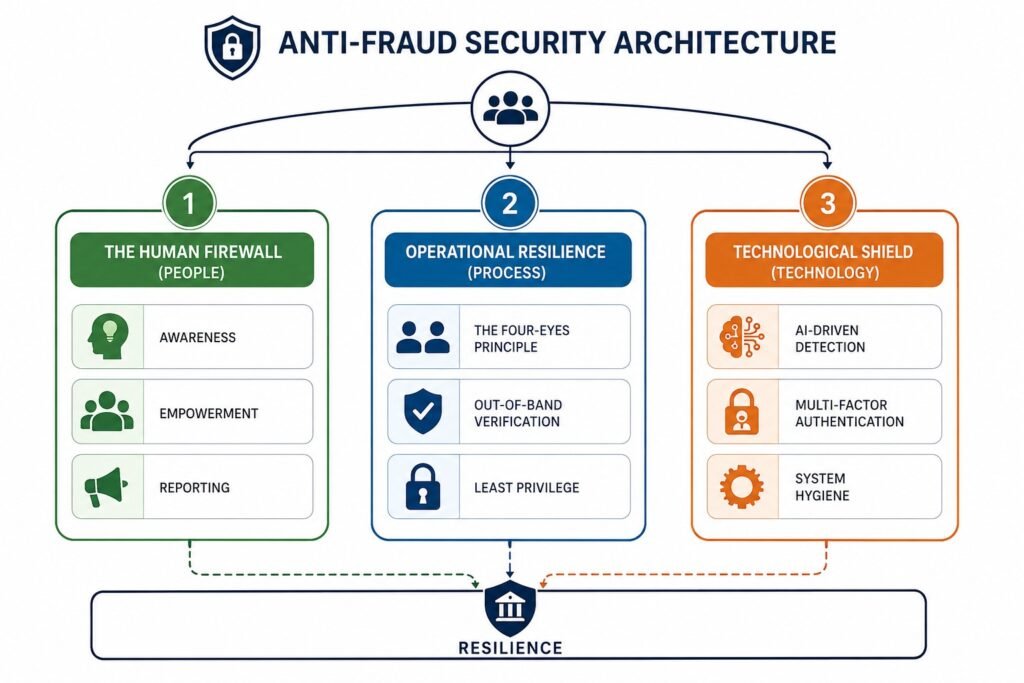
Model 1.0: Anti Fraud Security Architecture
Axelris Technologies uses a multi-layered approach to combat these evolving threats. We believe that security is not a single product you buy, but a culture you build. Our Anti Fraud Security Architecture is built on three essential pillars:
- The Human Firewall (People)
The first and most important line of defense. Technology can catch a virus, but only a human can sense that a request from the “CEO” feels “out of character.”
⦁ Awareness: Continuous training to recognize social engineering.
⦁ Empowerment: A culture where questioning a superior’s urgent payment request is rewarded rather than punished.
⦁ Reporting: Clear, non-punitive channels for flagging suspicious activity. - Operational Resilience (Process)
Even the best people need strong guardrails. Processes ensure that no single point of failure can lead to a catastrophic loss.
⦁ The Four Eyes Principle: Mandatory dual authorization for all sensitive transactions.
⦁ Out of Band Verification: Always verify changes to bank details through a separate, trusted channel (e.g., a known phone number, not the one in the email).
⦁ Least Privilege: Ensuring employees only have access to the financial systems necessary for their specific role. - Technological Shield (Technology)
Technology acts as the force multiplier for our people and processes.
⦁ AI Driven Detection: Using anomaly detection to flag unusual login locations or payment patterns.
⦁ Multi Factor Authentication (MFA): The baseline requirement for all internal and external systems.
⦁ System Hygiene: Keeping all software patched and up to date to close the doors fraudsters look for.
The Financial Reality of Fraud
We must look at the data to understand why every employee must be vigilant. The following table illustrates the most common types of organizational fraud and their typical impact as of early 2026.
| Fraud Type | Primary Method | Median Financial Loss | Non Financial Impact |
|---|---|---|---|
| Business Email Compromise (BEC) | Spoofed executive emails, fake invoices | $150,000 to $2,000,000 | Loss of vendor trust, legal fees |
| Social Engineering | Phishing, Vishing (Voice Phishing), Deepfakes | $50,000 to $500,000 | Compromised credentials, data breach |
| Invoice Manipulation | Intercepting and changing bank details | $25,000 to $1,000,000 | Operational delays, supply chain disruption |
| Executive Impersonation | High urgency “Boss” requests | $10,000 to $250,000 | Employee stress, reputational damage |
Chart 1.0: The Effectiveness of Training
Recent industry reports from 2026 show a direct correlation between regular fraud awareness training and the successful mitigation of attacks.
⦁ Organizations with monthly training: 85% success rate in catching BEC attempts.
⦁ Organizations with annual training: 40% success rate.
⦁ And Organizations with no training: 12% success rate.
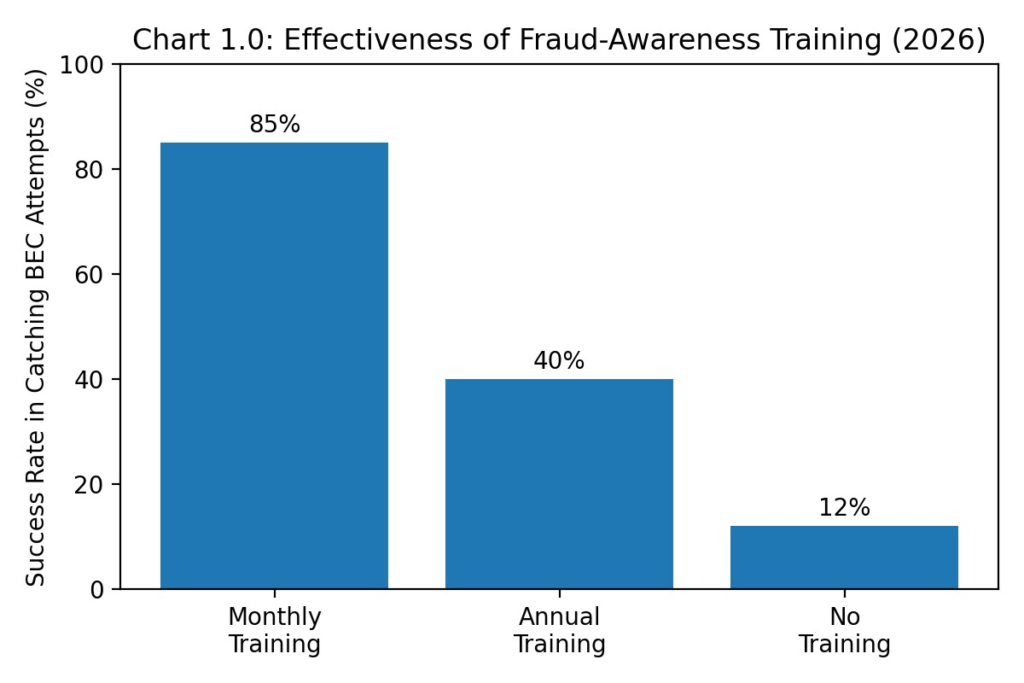
The data is clear: awareness isn’t just a “nice to have.” It is a mathematical necessity for protecting the bottom line.
The Summer Vacation Vulnerability
It is currently summer vacation time. For many, this means sunshine and relaxation. For fraudsters, it means opportunity. With managers on leave and temporary staff filling in, the “Four Eyes Principle” often breaks down.
Fraudsters use new technologies, such as Generative AI, to create incredibly realistic audio and video messages. They may call a junior accountant using a voice that sounds exactly like the CFO, claiming they are on vacation and need a “confidential” payment made immediately to secure a new deal.
Remember: Technology has made imitation easier, but it hasn’t made verification easier without a human check.
10 Practical Fraud Preventing Tips
Every employee, from the intern to the executive, should memorize and practice these ten principles.
- Pause if something seems more urgent than usual
Urgency is the fraudster’s greatest tool. By creating a false sense of crisis (e.g., “The contract will be lost in 20 minutes if you don’t pay now!”), They force you to skip the logical verification steps.
The Rule: The more urgent the request, the more slowly you should proceed. - Always verify new or changed bank account details before making a payment
If a long term vendor sends an email saying they have changed banks, do not trust the email. Fraudsters often compromise a vendor’s email account just to send these notifications.
The Action: Call a known contact at the vendor using a phone number from your internal system, not the number provided in the new email. - Use the “four eyes principle” for larger payments
No single person should have the power to initiate and complete a significant financial transaction.
The Action: A second person must independently review the details. If you are the second person, do not just “rubber stamp” it. Check the account numbers yourself. - Be cautious of unexpected messages, emails, or phone calls
Phishing is no longer just about poorly spelled emails. Modern “Spear Phishing” uses your LinkedIn profile, recent company news, and even your social media posts to craft a message that looks legitimate.
The Action: Treat every unsolicited request for information or money with healthy skepticism. - Verify unusual requests directly with the sender
If the CEO, who usually follows strict protocols, suddenly asks you to buy gift cards or wire money to a secret account, it is likely a scam.
The Action: Use a different channel to verify. If they emailed you, call them. If they texted you, send a message through the official company Slack or Teams. - Never share passwords or authentication codes
Multi Factor Authentication (MFA) is your strongest digital lock. Fraudsters will often call you pretending to be “IT Support” and ask for the code sent to your phone.
The Rule: A legitimate IT team will never ask for your password or your multi-factor authentication (MFA) code. - Check email addresses carefully
A common tactic is “typosquatting.” An email from john.doe@company.com might actually come from john.doe@cornpany.com (using an ‘r’ and ‘n’ to look like an ‘m’).
The Action: Hover your mouse over the sender’s name to see the actual underlying email address. - Keep software and security systems up to date
Security patches are released to fix “vulnerabilities,” digital holes that fraudsters use to enter your system.
The Action: When your computer asks to update, do it immediately. Don’t wait until the end of the week. - Report suspicious activity immediately
Fraud is like a fire. It spreads quickly. If you realize you clicked a suspicious link, don’t hide it out of embarrassment.
The Action: Tell IT or your manager immediately. Fast reporting can allow the company to freeze bank accounts before funds are moved. - Participate in regular fraud awareness training
The methods used by criminals change every month. Yesterday, it was simple emails. Today it is Deepfake audio.
The Action: Take the time to complete your organization’s security training. It is the most effective way to keep your “Human Radar” calibrated.
The Culture of Verification: “Pause, Verify, and Ask”
As Ib Knudsen noted, the goal is to build a culture where employees feel empowered to question. In many organizations, employees are afraid to question a request from a superior. Fraudsters exploit this hierarchy.
A “Culture of Verification” means:
⦁ Managers praise employees who catch potential fraud attempts.
⦁ The organization accepts that verification takes a few extra minutes and prioritizes security over speed.
⦁ “Trust but Verify” becomes the standard operating procedure for all financial interactions.
Conclusion: Let’s Build a Culture of Vigilance
This summer, let us commit to being extra vigilant. Let the “Pause and Verify” mantra be your guide. Whether you are a new intern or a senior executive, you are a vital part of the Axelris defense system. Fraud is a business risk that we face together. By following these tips and embracing our Anti-Fraud Security Architecture, we ensure that our reputation, our trust, and our operations remain secure.
Remember: When in doubt, stop, verify, and ask. A few extra minutes of diligence today can prevent a lifetime of damage. At Axelris Technologies, we protect our future by staying alert today.
© 2026 Axelris Technologies, Inc. All rights reserved.