From Data to Decisions: How Smart Analytics Is Reshaping Modern Businesses
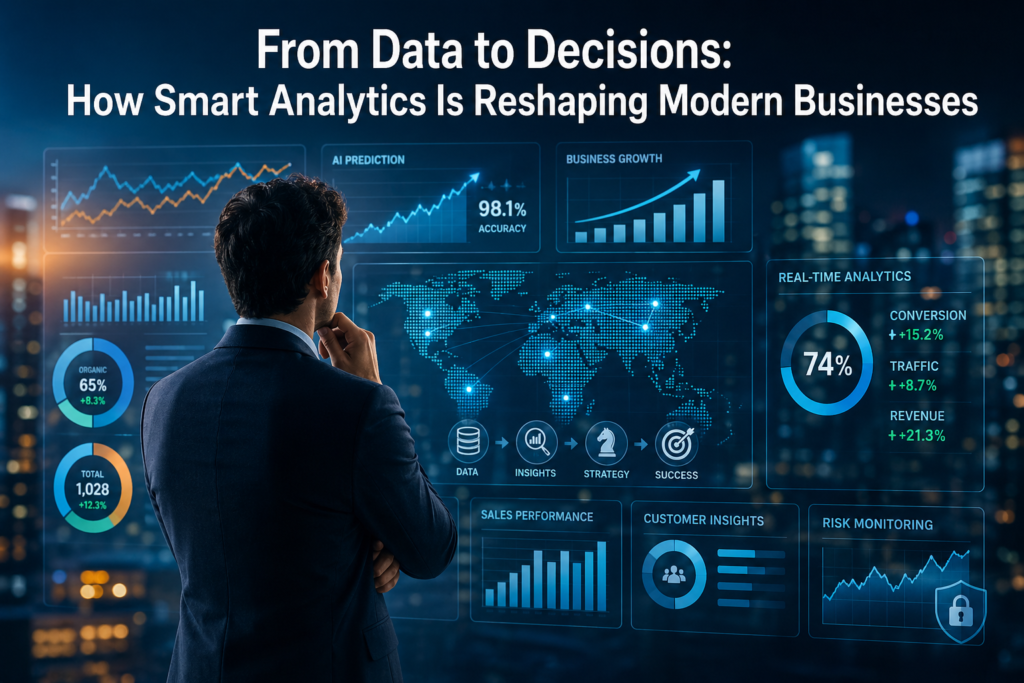
In the modern corporate world, data is often called the “new Oil,” a raw resource with huge value. But just like oil, raw data is not very useful on its own. It must be refined and turned into fuel for business decisions. As we move into 2026, the gap is growing between companies that just “have data” and those that actually “use data.” This shift is being led by Smart Analytics. This technology blends artificial intelligence (AI), machine learning, and real-time processing to change how companies work and compete.
The Data Deluge: Moving from Storage to Strategy
Every time a customer clicks a link, buys a product, or interacts with a brand, they leave a digital footprint. For years, businesses focused on “Big Data,” building huge systems to store every bit of info. But storing data is not the same as having a strategy. Today, many leaders feel “data fatigue.” They have so much information that they cannot make sense of it all.
Smart Analytics solves this problem. It goes beyond old-style Business Intelligence (BI). Traditional BI tells you what happened in the past. Smart Analytics tells you what will happen next. It even suggests the best way to react. It is like moving from a simple map to a high-tech GPS that predicts traffic before you even start driving.
Comparison: Traditional BI vs. Smart Analytics
| Feature | Traditional Business Intelligence (BI) | Smart Analytics |
|---|---|---|
| Focus | Historical (What happened?) | Predictive (What will happen next?) |
| Data Source | Structured, static databases | Real-time, diverse data streams |
| Output | Static reports and dashboards | Actionable recommendations (Prescriptive) |
| Processing | Manual or batch processing | Automated AI & Machine Learning |
| Outcome | Reactive decision-making | Proactive strategy |
The Axelris Perspective: A True Competitive Advantage
Companies must stop seeing analytics as just an IT task to truly succeed. It should be a core part of the business plan. This is especially true in areas like digital transformation and cybersecurity.
As Ib Knudsen, CEO of Axelris Technologies, Inc., says:
“Smart analytics, when properly implemented and fully utilized, can be transformed into a true competitive advantage in today’s competitive environment.”
This quote highlights a key fact: the real value lies not just in the software. It is in how you implement and use it. For a company like Axelris, which focuses on “Security That Thinks Ahead™,” smart analytics is the foundation of defense.
In a world where cyber threats change in a heartbeat, waiting for a person to read a log file is too slow. Smart analytics can identify patterns that show an attack is coming. This allows businesses to stop threats before they cause any harm.
Why Smart Analytics Is Essential for Modern Businesses
For many years, business leaders made decisions based on experience, instinct, and past patterns. They trusted their gut and used their industry knowledge to handle challenges. While experience is still useful, this approach can be risky in today’s fast-changing markets. Biases, limited information, and emotions can affect judgment. As a result, leaders may overestimate opportunities or fail to see possible threats. Research shows that companies that use data are 23 times more likely to gain customers and 6 times more likely to retain them.
The main issue with intuition-based leadership is its inconsistency and exposure to personal bias. Confirmation bias makes people focus only on information that supports their beliefs. Overconfidence can lead to decisions made without proper evidence.
Data does not replace human thinking, but it helps test ideas and check assumptions. Many organizations now understand that the best approach is to combine data insights with experience, creating stronger and more reliable decision-making systems.
How Analytics Reduces Uncertainty
Analytics turns guesswork into clear facts. It finds patterns and warning signs in data that humans might miss. Instead of reacting to problems after they happen, data-driven businesses spot risks early when they are easier to fix.
Predictive models can even detect potential breakdowns before they occur. This allows companies to adjust their plans and avoid expensive mistakes. By tracking internal data and market trends in real-time, businesses can be proactive rather than just scrambling to react to every crisis.
The Competitive Edge
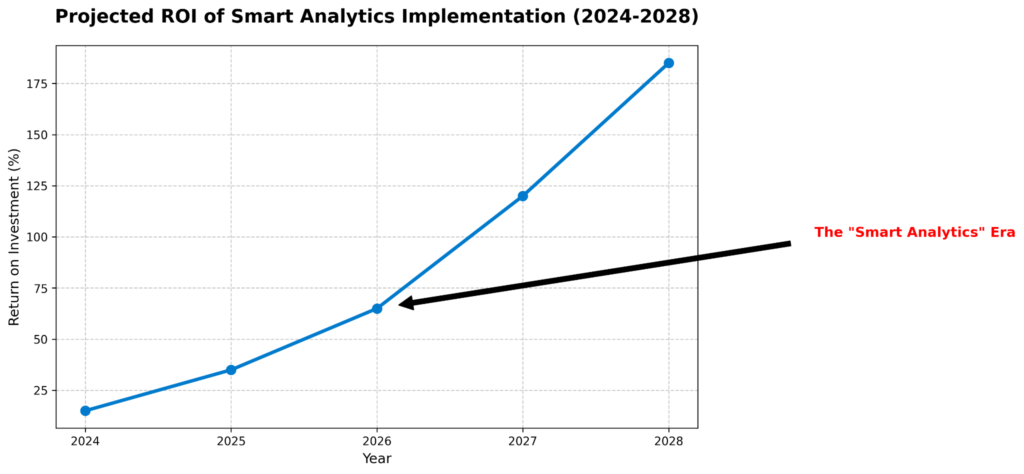
Companies that prioritize data see a massive boost in performance. They can increase their profits (EBITDA) by 15 to 25%. Because they use real-time data, they can respond to market changes faster than their competitors.
These organizations also find ways to save money and improve efficiency that others miss. They achieve much higher value from their customers because they truly understand what those customers need and want.
The gap between data-driven companies and their competitors is growing. Success isn’t just about having the fanciest technology. It’s about speed and accuracy. Companies that use data see better results across the board: higher revenue, lower costs, and happier customers.
Key Technologies Powering the Smart Analytics Revolution
Several new technologies are making Smart Analytics more powerful and easier to use.
- Predictive and Prescriptive Modeling
Predictive analytics uses past data to guess what will happen in the future. For example, a factory can use sensors to predict if a machine will break down in two weeks. Prescriptive analytics goes even further. It suggests what to do like fixing the machine during a quiet time and ordering parts automatically. - Generative AI and Augmented Analytics
Generative AI has changed how we talk to our data. With “Augmented Analytics,” you don’t need to be a coding expert to get answers. You can ask questions in plain English, such as: “Show me how our security spending affected our response times last month.” The system then creates the charts and explains the results for you. This makes data accessible to everyone in the company, not just the data scientists. - Edge Analytics
As more devices connect to the internet (IoT), we need to process data right where it is collected. This is called “Edge Analytics.” Instead of sending all data to a central cloud, smart devices analyze it locally. They only send the most important findings. This saves time and is vital for things like self-driving cars or factory robots.
Reshaping Industries: Real-World Impact
Cybersecurity: Proactive Defense
At Axelris Technologies, smart analytics acts as a force multiplier. Modern security is no longer just about building a wall. It is about building a smarter brain. By using machine learning on network traffic, businesses can find “zero-day” threats. These are attacks that have never been seen before. The system spots them because they act differently from normal traffic. This “Security That Thinks Ahead™” approach is only possible with smart analytics.
Supply Chain Resilience
Global supply chains have been very unstable lately. Smart analytics helps companies run “what-if” tests. They can simulate port closures or raw material price spikes. By creating a “Digital Twin” of their supply chain, businesses can test their resilience and adjust their stock levels in real time. This helps them stay open even when problems occur.
Hyper-Personalized Customer Experience
In retail, smart analytics has moved beyond simple groups. It now allows for “hyper-personalization.” Every interaction is tailored to a customer’s specific needs and current context. This leads to higher sales and builds stronger brand loyalty. When a customer feels like a brand “gets” them, they are much more likely to return.
Financial Services: Fraud Detection and Risk
Banks and financial firms use smart analytics to stop fraud before it happens. By analyzing millions of transactions in real-time, AI can spot a suspicious purchase and block it instantly. It also helps in credit scoring, allowing lenders to make better decisions about who to lend money to, based on more than just a simple credit score.
Deep Dive: The Journey from Data to Wisdom
We can look at the “DIKW” pyramid: Data, Information, Knowledge, and Wisdom to understand how smart analytics works.
⦁ Data: The raw facts and figures. On their own, they mean nothing.
⦁ Information: data that has been organized. It answers questions like “who,” “what,” and “when.”
⦁ Knowledge: This is where we start to see patterns. It answers the “how” questions.
⦁ Wisdom: This is the peak. It is the ability to use knowledge to make the right decisions for the future.
Smart analytics automates the climb from the bottom to the top of this pyramid. It takes the heavy lifting out of data processing, allowing human leaders to focus on “Wisdom,” the strategic choices that define a company’s future.
Overcoming the Challenges of Implementation
While the benefits are clear, the path to becoming data-driven is not always easy. Companies must overcome several hurdles:
- Breaking Down Data Silos
In many companies, data is trapped in different departments. The sales and operations teams each manage their own data separately. For smart analytics to work, this data must be brought together. A holistic view is the only way to find truly deep insights. - Ensuring High Data Quality
There is an old saying in computer science: “Garbage in, garbage out.” If your data is messy or incorrect, your analytics will be too. Investing in data cleaning and governance is a must. You need to trust your data before you can trust your decisions. - The Talent Gap
You need people who know how to work with these new tools. This doesn’t mean everyone needs to be a mathematician. But it does mean that teams need to be trained to understand and use data in their daily work. Axelris Technologies often helps clients with this transition, providing the expertise needed to scale. - Ethics and Privacy
As we collect more data, we must also be more careful. Customer privacy is a top priority. Businesses must use AI and data ethically and in compliance with all laws. Transparency is the key to keeping the trust of your clients.
The Future: What Comes After “Smart”?
Analytics will become even more integrated into our lives. We are moving toward “Continuous Intelligence,” where analytics is embedded into every single business process. There will no longer be a separate “analytics department.” It will simply be the way every department operates.
Generative AI will continue to evolve, moving from just answering questions to actually taking actions. Imagine an AI that doesn’t just tell you that inventory is low, but actually negotiates with suppliers to get the best price and places the order for you.
Conclusion
The path from data to decisions is the biggest challenge of our time. Smart analytics is no longer a “nice to have.” It is the heart of modern business. It turns the chaos of the digital world into a clear path for growth. Ib Knudsen’s message is clear. If you implement these tools well, you gain a massive lead. You stop guessing. You start knowing.
At Axelris Technologies, we are here to help you make that leap. Let’s turn your data into the biggest competitive advantage. We help businesses simplify, secure, and scale.We provide the smart IT and cybersecurity tools you need to win. Visit Axelris.com today. Let’s build your future together.
© 2026 Axelris Technologies, Inc. All rights reserved.