
Downtime Risk: Why Managed Cybersecurity Services Are A Smart Strategic Investment
In the hyper-connected economy of 2026, operational continuity has transitioned from a technical requirement to a boardroom imperative. For mid-size organizations, the financial impact of cybersecurity-induced downtime is no longer a peripheral risk but a direct threat to enterprise value. The average downtime costs now for midsize businesses are over $14,000 per minute, while large enterprises can face losses of up to $23,750 per minute. This article examines the shift from reactive defense to managed resilience, positioning Managed Security Service Providers (MSSPs) not as an outsourcing expense, but as a strategic lever for competitive advantage.
The Anatomy of Downtime in 2026: A New Scale of Loss
The definition of downtime has evolved. In previous decades, “downtime” meant a server was offline, or an email system was delayed. In 2026, it encompasses the total paralysis of an organization’s digital nervous system. As organizations have integrated agentic AI, automated supply chains, and real-time data lakes into their core operations, the “surface area of failure” has expanded exponentially.
According to the ITIC 2024 Hourly Cost of Downtime Survey, 90% of mid-sized and large enterprises report that a single hour of downtime now averages more than $300,000. In high-stakes sectors like manufacturing and financial services, this figure often exceeds $1 million. The erosion of value occurs across three distinct horizons:
Horizon 1: Immediate Financial Bleed
The most visible cost is the “burn rate” of idle resources. A 500-person organization with an average salary of $90,000 carries a labor cost of approximately $22,000 per hour. When systems are down, this is pure loss. When combined with direct revenue leakage, unprocessed orders, missed service level agreements (SLAs), and halted production lines, the immediate financial impact is staggering.
Horizon 2: The Compounding Recovery Friction
Recovery rarely involves simply “turning the lights back on.” Downtime carries hidden costs, such as the technical debt created by emergency fixes, the forensic expenses of identifying the source of the breach, and the overtime pay for IT teams working 72-hour shifts to restore integrity. Furthermore, the “catch-up” period post-restoration often sees a 20-30% drop in overall productivity as employees struggle with backlogs and system instability.
Horizon 3: Permanent Brand Dilution and Trust Erosion
This is the most critical horizon for board members. In an era of instant information, a cyber outage becomes public news within minutes. For mid-market firms, reputation is often their primary differentiator against larger, more commoditized competitors. A single high-profile outage can trigger customer churn that takes years to reverse.
As Ib Knudsen, C.E.O. of Axelris Technologies, Inc., aptly notes:
“Operational continuity is a competitive advantage. Downtime is what happens when it’s left unprotected.”
The 2026 Threat Landscape: AI-Driven Volatility
Why managed services are necessary, one must understand the adversary. In 2026, the primary threat is no longer the “lone hacker” but highly organized, AI-powered syndicates.
The Rise of Automated Adversaries
Attackers are now using “Adversarial AI” to conduct reconnaissance on an unprecedented scale. They can scan millions of mid-market networks for a specific, newly-discovered vulnerability in minutes. This speed of attack makes manual, human-led defense impossible. By the time an internal IT team receives an alert, the encryption process or data exfiltration is often already complete.
The Weaponization of Identity
Deepfakes and sophisticated social engineering have rendered traditional “perimeter” defenses obsolete. Attackers no longer “break in”; they “log in” using stolen or spoofed identities. This shift requires a “Zero Trust” architecture and continuous behavioral monitoring capabilities that are complex to build and even harder to maintain in-house.
The Resilience Gap in the Mid-Market
Midsize organizations face a unique “Resilience Gap.” They possess the operational complexity of an enterprise but lack the $10M annual budget required to maintain a world-class, 24/7 Security Operations Center (SOC). This gap is the primary reason why mid-market firms have become the preferred target for ransomware groups: they are “rich enough to pay, but weak enough to break.”
The Strategic Model: The Cybersecurity Resilience Maturity Matrix
Navigating this environment requires a shift in mental models. We propose the Cybersecurity Resilience Maturity Matrix as a framework for executive decision-making.
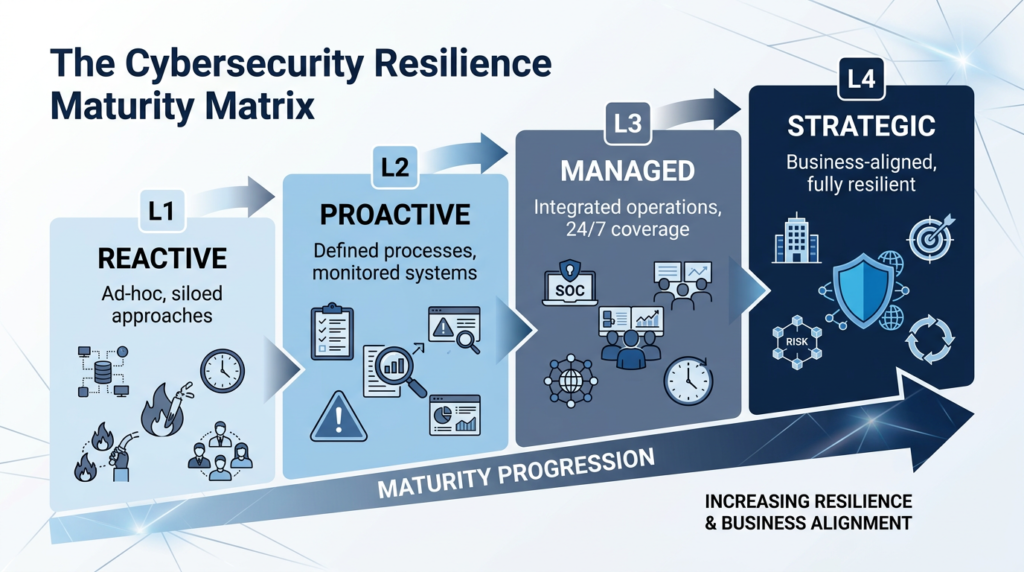
Figure 1: The progression from ad-hoc response to business-aligned resilience.
Maturity Level 1: Reactive (The Danger Zone)
At this stage, security is viewed as an IT “problem.” Protection is ad-hoc, siloed, and primarily focused on legacy antivirus and firewalls. Organizations at this level spend most of their budget on “firefighting” after an event has occurred.
Maturity Level 2: Proactive (Basic Hygiene)
The organization has defined policies and basic incident response plans. There is monitoring, but it is often limited to business hours. While better than Level 1, this posture is still insufficient against 2026-era automated threats.
Maturity Level 3: Managed (The Strategic Pivot)
This is where the transition to an MSSP typically occurs. Security is 24/7/365. Detection and response are seamlessly integrated with real-time global threat intelligence. The focus shifts from “prevention” (which is never 100%) to “rapid detection and containment.”
Maturity Level 4: Strategic (Competitive Advantage)
At the highest level, security is woven into the business strategy. Resilience is a core value proposition shared with customers. The organization can withstand a major attack with zero significant downtime, using adaptive defenses that “learn” from every attempt.
Managed Services: Shifting from Cost Center to Strategic Asset
The traditional view of cybersecurity as a “cost of doing business” is being replaced by the concept of the Resilience Dividend. This dividend is the measurable value created by ensuring that an organization can continue to operate and even gain market share while its competitors are sidelined by disruptions.
The Economic Case for Managed Security (MSSP)
1) Talent Arbitrage: The global shortage of cybersecurity professionals has driven salaries to levels that make internal hiring prohibitive for many mid-sized firms. An MSSP aggregates this talent, allowing you to “rent” elite expertise for a fraction of the cost of a single full-time hire.
2) Technological Superiority: The cost of the “Security Stack” (SIEM, XDR, SOAR, AI-monitoring) is immense. MSSPs invest millions in these tools and spread the cost across hundreds of clients, giving you access to the “sharpest tools” without the capital expenditure.
3) The 24/7 Mandate: Cyberattacks do not happen between 9:00 AM and 5:00 PM. Building an internal team to cover 168 hours a week requires at least 10-12 people. For most mid-market firms, this is financially irrational compared to an MSSP subscription.
Strategic Comparison: In-House Build-Out vs. Managed Services
For a board-level review, the choice between “Building” and “Partnering” should be evaluated across these strategic dimensions:
| Strategic Dimension | In-House Build-Out (DIY) | Managed Security Service (MSSP) |
|---|---|---|
| Talent Acquisition | Great difficulty; constant turnover risk. | Immediate access to specialized, elite teams. |
| Technology Stack | Heavy CapEx; risk of rapid obsolescence. | OpEx model; continuous “state-of-the-art” tech. |
| Threat Intelligence | Limited to internal network visibility. | Global visibility across multi-industry datasets. |
| Response Time | 8/5 or 12/5 (typically). | Guaranteed 24/7/365 proactive monitoring. |
| Operational Focus | The IT team is distracted by security maintenance. | The IT team focuses on core business innovation. |
| Scalability | Slow; requires hiring and training. | Immediate; scales with your business growth. |
The ROI of Resilience: Quantifying the Investment
Investment in managed services must be justified with data. The chart below illustrates the “Efficient Frontier” of cybersecurity spending.
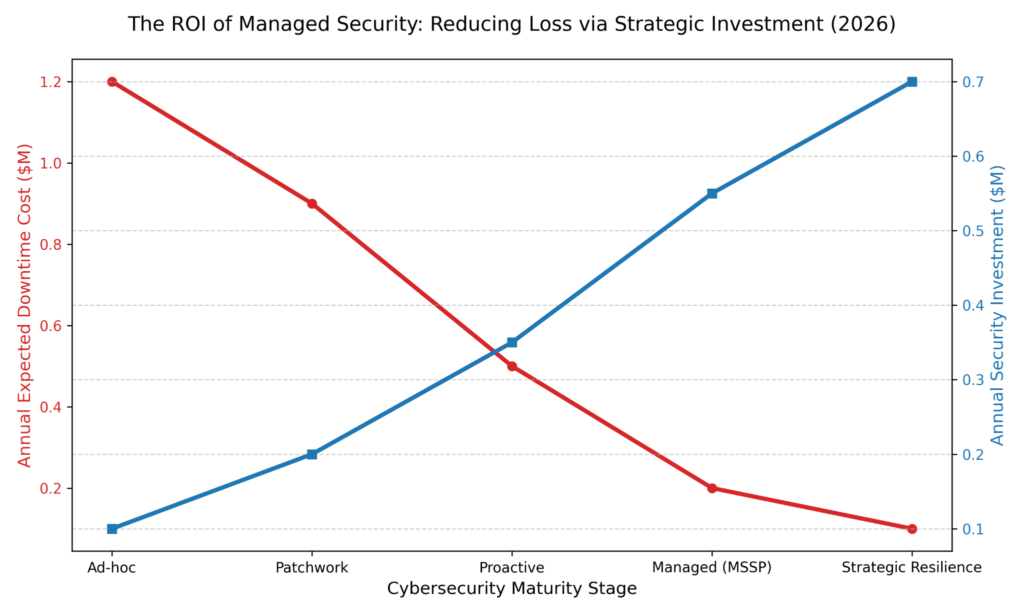
Figure 2: Analysis showing how strategic investment in MSSP drastically reduces the “Expected Loss” from downtime.
As organizations move from Level 1 (Ad-hoc) to Level 4 (Strategic), the Expected Cost of Downtime drops precipitously. The company’s goal is to reach the “Managed” stage, where the cost of protection stays significantly lower than the “Value at Risk.” In 2026, experts often calculate the ROI of moving from a reactive to a managed posture at 300% to 500% when they account for the prevention of even a single major outage.
Roadmap for the Board: Moving Toward Resilience
Transitioning to a managed model requires a structured approach. Leaders should consider the following three-step roadmap:
Step 1: Conduct a “Value-at-Risk” Audit
Before choosing a partner, quantify the cost of an hour of downtime for your specific business units. Move beyond “average” numbers to identify your “Crown Jewels,” the data and systems that, if lost, would end the company.
Step 2: Evaluate Partners on “Time-to-Containment”
In 2026, the most important metric is not “Time-to-Detection” but “Time-to-Containment.” Ask prospective MSSPs: “How quickly can your AI systems isolate an infected endpoint without human intervention?”
Step 3: Cultural Alignment
Managed security is a partnership, not just a service. Ensure that your internal IT team views the MSSP as a “force multiplier” rather than a replacement. The most successful organizations are those where the MSSP handles the “noise” (monitoring and basic response), while the internal team handles the “signal” (aligning security with business goals).
Conclusion: The Board-Level Mandate
In the landscape of 2026, cybersecurity has transcended its technical roots to become a core pillar of fiduciary responsibility. A board that treats downtime as an “IT problem” is neglecting its duty to protect shareholder value.
Managed Cybersecurity Services provide the scale, speed, and sophistication required to thrive in a hostile digital environment. Leaders are not just preventing downtime by making smart strategic investments today. They are securing the foundation for their future growth and ensuring that their organization remains a resilient leader in tomorrow’s competitive marketplace.
Copyright © 2026 Axelris Technologies, Inc. All rights reserved.