
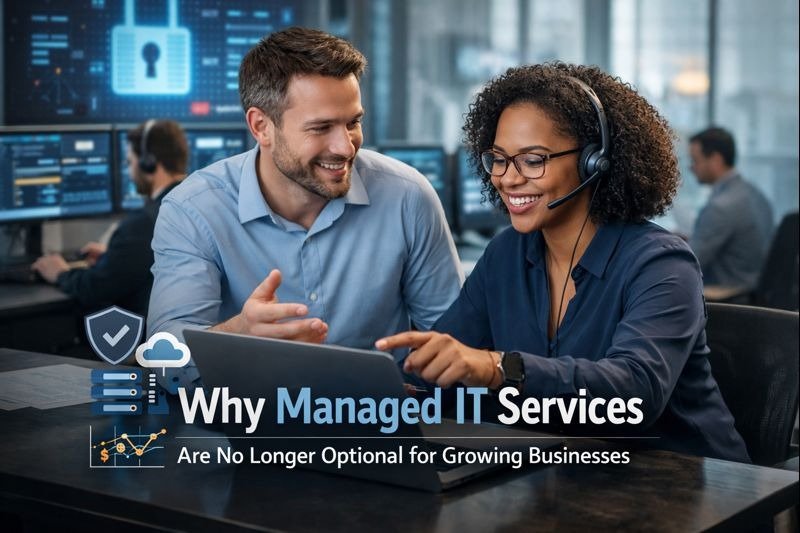
Why Managed IT Services Are No Longer Optional for Growing Businesses
Growth is exciting until your technology becomes the bottleneck. As headcount rises, new tools get added, more customer data flows through your systems, and “quick fixes” turn into permanent infrastructure. Suddenly, IT is no longer just about keeping computers running. It becomes a core business function that directly impacts revenue, compliance, customer experience, and how fast your company can scale.
That’s why many decision-makers are no longer asking, “Should we outsource IT?” to “What parts of IT should we not outsource?” Managed IT services are not simply an alternative to internal hiring. They offer a practical way to achieve enterprise level security and reliability without building a large IT department. This article explores why managed IT services are now essential for growing businesses.
The New Reality: IT Risk is Now Business Risk
In 2026, cybersecurity isn’t just an IT issue anymore. It is a board level business risk. According to the World Economic Forum Global Cybersecurity Outlook 2025, cyber threats now rank among the top three global business risks, alongside inflation and supply chain disruption. More than 45% of organizations identify cyberattacks as their most significant operational threat.
On average, a data breach costs 4.45 million worldwide. But financial loss is only part of the damage. Modern IT risks impact businesses in several ways:
- Financial losses: Legal fees, regulatory penalties, and lost revenue
- Operational disruptions: Ransomware can shut down systems and halt operations
- Strategic setbacks: Stolen intellectual property weakens competitive advantage
- Compliance penalties: Regulations like GDPR can impose fines of up to 4% of annual global revenue
- Reputational damage: Loss of customer trust can take years to recover
About 95% of cybersecurity incidents are caused by human error. That’s a major reason managed IT services matter for growing businesses.
Technology risk now affects every part of the organization systems, data, IP, and reputation. Security isn’t just the IT team’s job anymore. It is a leadership responsibility that requires structured, ongoing protection.
Why “Just Hire One IT Person” Breaks Faster than it Used to
For years, small and mid sized businesses relied on a familiar model: hire one capable IT professional and let them “handle everything.” That model collapses under modern demands.
A common path for growing businesses is:
- A tech savvy employee becomes the unofficial IT person
- You hire a generalist IT admin
- They get overwhelmed
- You add another hire, then another
- You still have gaps (security, cloud, compliance, 24/7 response, documentation)
This happens because modern IT isn’t one job, it’s many specialties:
- Endpoint management (laptops, mobile devices, patching)
- Identity and access management (SSO, MFA, permissions)
- Cloud administration (Microsoft 365/Google Workspace/Azure/AWS)
- Networking and Wi-Fi
- Backups and disaster recovery
- Cybersecurity monitoring and incident response
- Vendor management and licensing
- Help desk and onboarding/offboarding
- Compliance controls and audits
A small internal team can absolutely succeed, but only if leadership is ready to fund depth (specialists), redundancy (coverage), and tooling (monitoring/security stack). If not, the organization usually ends up with single points of failure and reactive firefighting.
Managed IT Services: What you’re Really Buying
When you engage a managed IT provider, you’re not just paying for “support tickets.” Underneath the service agreements and monthly fees lies a fundamental shift in how technology serves a business.
You’re buying a system, people, process, and tools designed to deliver:
- Proactive monitoring to prevent outages before they happen
- Standardized configurations for security and consistency
- Predictable costs through per-user or per-device pricing
- Coverage and redundancy so no single person holds all the knowledge
- Security maturity with patching, alerts, and response plans
- Operational structure through reporting, reviews, and roadmaps
Ultimately, managed IT services represent a partnership rather than just a vendor relationship. The core value lies in transferring technology risk from the business to specialists equipped to handle it. This arrangement lets business leaders focus on growth strategies instead of technology problems.
These services provide predictability in costs, performance, and security posture. For small and growing businesses, this turns IT from an unpredictable problem into a stable, manageable operating cost.
Most managed IT providers also provide flexible service packages. This makes advanced, enterprise level IT support affordable and accessible, even for smaller businesses.
In-house vs. Managed IT: A Decision Maker Comparison Table
When evaluating technology management options, business leaders must weigh several critical factors between in-house IT teams and managed service providers. Here’s a straight comparison for leaders weighing the trade offs:
| Category | In-House IT Team | Managed IT Services (MSP) |
| Upfront setup | Hiring, onboarding and plus tool selection takes time | Faster onboarding with proven tools/process |
| Skill coverage | Limited unless you hire specialists | Access to broader bench of specialists |
| Availability | PTO/illness can create gaps | Coverage built into the service model |
| Security posture | Depends heavily on internal maturity | Often includes standardized security controls & monitoring |
| Scalability | Grows slowly (hire to demand lag) | Scales quickly as users/devices grow |
| Cost structure | Salaries, benefits, tools and training | Predictable monthly fee (often per user/device) |
| Documentation | Often inconsistent | Typically formalized as part of delivery |
| Vendor management | Internal burden | MSP manages vendors, renewals, support escalations |
| Strategic planning | Can be strong if senior IT leadership exists | Often includes vCIO/vIT manager guidance (service-dependent) |
For many growing businesses, the practical conclusion is In-house is best for deep business-specific systems and strategy. Managed IT is best for day-to-day reliability, security, and scale.
That’s why co-managed IT is becoming common: leadership keeps strategic control while outsourcing the operational load.
Graph: Why Managed IT Wins on Predictability
Below is a conceptual graph showing how IT costs tend to behave over time.
In-house (especially small teams) often produces spiky costs: outages, emergency consultants, rushed hardware replacements, security incidents.
Managed IT typically produces flatter, more predictable costs due to proactive maintenance and bundled tooling.
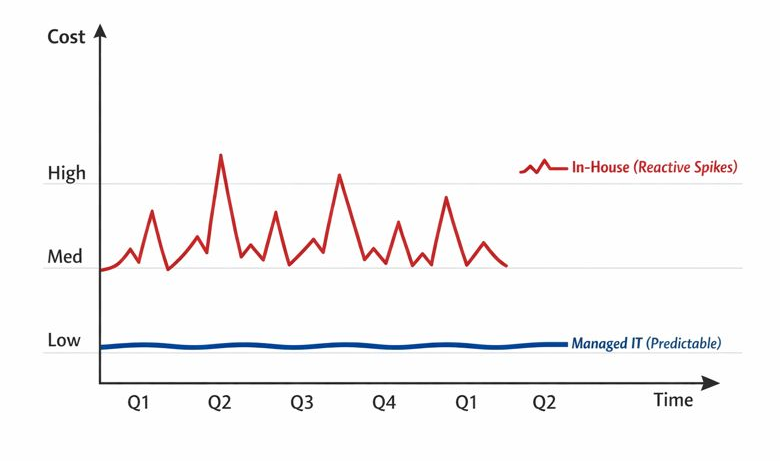
This is exactly what finance leaders want: fewer “surprises,” more forecastable spend, and fewer incidents that derail operations.
Why Managed IT is Becoming Essential Now?
The urgency for managed IT services has never been greater. According to the World Economic Forum, cyber threats in 2025 will become significantly more sophisticated, with ransomware, social engineering, and AI driven cybercrime remaining top concerns.
Businesses face unprecedented pressure to adopt professional IT management solutions now rather than later.
1) Cyber Threats Are Growing Faster
Cyberattacks are growing every year and becoming increasingly damaging. New tools, including AI, allow attackers to move faster and cause greater harm in less time. The data breach cost has also increased.
On average, a single breach now costs businesses USD 4.88 million. For many growing companies, one serious incident can cause long term financial and operational damage. Managed IT services help reduce this risk by monitoring systems continuously and responding quickly when threats appear.
2) Compliance Requirements Keep Increasing
Businesses today must follow more data protection and cybersecurity regulations than ever before. These rules change often and can vary by country or region.
Compliance is no longer something you check once or twice a year. It needs ongoing monitoring, documentation, and controls. Without proper IT management, businesses risk such things as regulatory investigations, heavy fines and damage to their reputation. Managed IT providers help businesses stay compliant by implementing the right security controls and processes.
3) IT Systems Are More Complex Than They Appear
Modern IT environments include cloud computing platforms, telecommuting tools, security applications, and many other interconnected systems. Small businesses usually have many tools to manage.
This complexity makes it difficult for small internal teams to fully understand and manage everything. When systems rely on “tribal knowledge” held by one or two people, the risk increases if those people leave or become unavailable. Managed IT services bring structure, documentation, and visibility, making IT easier to manage and less dependent on individuals.
4) Skilled IT Talent Is Expensive and Hard to Find
Hiring skilled IT workers has become extremely challenging. The world is becoming short of skilled employees, particularly in fields such as cybersecurity, cloud systems, and infrastructure management.
Not every company can afford to employ several experts or cover 24/7. Managed IT services address this issue by providing businesses with access to a complete team of professionals at a fixed price.
What Should Growing Businesses Outsource vs. Keep In house?
Making strategic decisions about which IT functions to outsource versus manage internally helps growing businesses optimize resources. A practical split that works well:
Often outsource (best fit for MSP delivery):
- Help desk and end user support (Tier 1/2)
- Monitoring, patching and maintenance
- Endpoint management (MDM, laptop standards, encryption)
- Backup and disaster recovery testing
- Email security, MFA enforcement, baseline cybersecurity
- Vendor support escalations
- Documentation and IT asset tracking
Often keep in-house (best fit internally):
- Business-specific systems ownership (ERP, proprietary tooling)
- Application strategy and transformation
- Internal product/engineering IT needs
- High context workflows requiring deep internal knowledge
- Executive level technology roadmap decisions (or co-lead with MSP)
If you don’t have internal IT leadership, look for an MSP that offers a vCIO/vIT manager function (strategic guidance, budgeting, lifecycle planning).
Ultimately, hybrid models are becoming the default approach. This balanced strategy allows companies to retain strategic control internally while leveraging specialized external expertise for operational functions.
How to Choose a Managed IT Service Provider
Selecting the right managed IT service provider requires careful evaluation of multiple factors beyond just price. Successful partnerships begin with thorough vetting across several dimensions to ensure alignment with your business needs.
A selection process should include these critical assessment areas:
- Service level agreements: Check the guaranteed response times by severity level and ensure they align with your operational needs.
- Security credentials: Seek providers with up to date certifications such as SOC 2, ISO 27001, or industry compliance certificates.
- Technical skill: assess their experience with your technology stack and industry sector.
- Business continuity capabilities: Evaluate their disaster recovery procedures and redundancy mechanisms.
- Scalability capability: Ensure they can handle your estimated growth without service failures.
- Cultural fit: Review their communication style and company values in relation to yours.
During the evaluation process, seek client references particularly with organizations of similar sizes and industries as yours. Also, review their escalation policies when problems go beyond normal response procedures.
Similarly, do not ignore contractual terms regarding termination conditions, data ownership, and intellectual property. The optimal provider must be flexible in service levels since your requirements may change over time.
Conclusion: Managed IT Is a Growth Enabler
Managed IT services have shifted from a “nice to have” to a core business requirement. They reduce risk, stabilize costs, improve security, and free leadership teams to focus on growth instead of firefighting. In a world where technology underpins every operation, professional IT management is no longer optional. It is foundational.
Businesses that adapt now position themselves for resilience and competitive advantage. Those who delay expose themselves to escalating risk, financial instability, and operational disruption. The question is no longer whether managed IT services are worth the investment, but whether growing businesses can afford to operate without them.
© 2026 Axelris Technologies International, Inc. All rights reserved