Cyberattacks are no longer a matter of “if” they’re a matter of “when.” Ransomware attacks are up, and demands are getting bigger every year. Phishing and Business Email Compromise (BEC) attacks are more convincing than ever. Most organizations don’t have the in house talent, tools, or time to monitor threats 24/7. The average business takes days to detect a breach attackers only need minutes. The gap between attack and detection is where businesses lose money, data, and trust.
What is Managed Detection and Response (MDR)?
Managed detection and response (MDR) is a cybersecurity service that helps proactively protect organizations from cyberthreats using advanced detection and rapid incident response.
It is a fully managed cybersecurity service that combines,
- Advanced detection technology (SIEM, EDR/XDR)
- Real human security analysts
- 24/7/365 monitoring, threat hunting, and rapid incident response
How Our Process MDR Works
Threat Discovery → Validation → Risk Scoring → Containment → Eradication → Recovery → Root Cause Analysis → Preventive Hardening
- Prioritize We cut through alert noise and separate real threats from false positives.
- Hunt Our analysts proactively search for hidden and dormant threats, 24/7
- Investigate Every alert is validated and investigated by a human expert
- Remediate We isolate, contain, and stop the attack from spreading
- Neutralize We fix the root cause so it doesn’t happen again
Core Capabilities
Continuous Ai-native Cybersecurity Platform
24/7 monitoring across endpoints, network, cloud, and identities
Expert Analysis
Every critical alert is validated by a real analyst, not just a machine
Rapid Incident Response
Immediate isolation and containment to minimize business disruption
Proactive Threat Hunting
Hunting for unknown, zero day, and dormant threats before they strike
Full Visibility and Reporting
Executive ready dashboards and compliance reports
Seamless Integration
Works with your existing firewalls, SIEM, and EDR no rip and replace
| Service Tier Comparison Axelris Managed MDR | ||||
| Tier | Scope Highlights | Support and SLA | Key Components | Ideal For |
|---|---|---|---|---|
|
Tier 1 Maintenance and Monitoring |
Basic upkeep (patching, backups), 24/7 monitoring and alerting, routine maintenance. | 8×5 support; critical response <4 hrs; ~99% uptime target. | Uptime Monitoring, Patch Management, Backups, Threat Advisory, Ticketing | Organizations needing foundational coverage and reliable upkeep |
|
Tier 2 Hardening and Testing |
Proactive hardening, vulnerability scans, quarterly assessments, annual pentest, compliance audits. Includes Tier 1. | 12×5 support; critical response <2 hrs; ~99.5% uptime target. | Vulnerability Scanners, Pentesting Tools, SIEM, Ticketing and Documentation | Organizations preparing for audits or facing growing compliance demands |
|
Tier 3 Managed SecOps (Full MDR) |
Full 24/7 threat monitoring, incident response, continuous threat hunting, advanced SIEM/XDR, compliance management. Includes Tier 1 and 2. | 24×7 on-call; critical response <1 hr; 99.9% uptime SLA; formal IR playbooks. | SIEM+EDR/XDR, SOAR, Threat Intel Feeds, Identity Security, DevSecOps Integration | Organizations wanting a fully outsourced, enterprise-grade SOC |
Tier 1 Maintenance and Monitoring
Scope
Basic upkeep of your platform and infrastructure patching, backups, 24/7 systems monitoring and alerting, routine maintenance.
Support and SLA
Business hours support (8×5); critical incidents responded to within 4 hours; ~99% uptime target.
Tier’s 1 Components
- Uptime Monitoring and Alerts
- Patch Management Solution
- Backup Solutions
- Cybersecurity Advisory and Threat Intelligence
- Ticketing Solution
Uptime Monitoring and Alerts
- Your systems are watched continuously, so if something goes down or starts behaving abnormally, you know immediately not hours or days later when a customer complains.
- Unplanned downtime costs money, damages customer trust, and often signals a bigger problem brewing underneath.
- Real time alerting catches issues at the first sign of trouble, allowing action before a small glitch becomes a major outage.
Patch Management Solution
- All your software and systems stay up to date with the latest security fixes, automatically and consistently.
- The majority of successful cyberattacks exploit known vulnerabilities that already have a patch available attackers rely on organizations being slow to update.
- By closing these gaps quickly and consistently, we eliminate one of the most common and easily preventable entry points attackers use.
Backup Solutions
- Your critical data is regularly and securely backed up, so it can be restored if something goes wrong.
- Ransomware, hardware failure, and human error can all result in data loss without backups, that data may be gone forever.
- Reliable backups mean that even in a worst-case scenario, your business can recover quickly instead of paying a ransom or losing operations entirely.
Cybersecurity Advisory and Threat Intelligence
- You get ongoing guidance from security experts about emerging threats relevant to your industry and environment.
- Most businesses don’t have the internal expertise to track the constantly evolving threat landscape.
- Proactive advisory means you’re prepared for threats before they target you, not just reacting after an attack.
Ticketing Solution
- Every issue, request, and incident is logged, tracked, and resolved through a clear, accountable process.
- Without proper tracking, issues get lost, forgotten, or take longer to resolve and there’s no record for compliance or review.
- A structured ticketing system ensures nothing falls through the cracks and gives you full visibility into what’s being worked on and when it will be resolved.
Tier 2 Hardening and Testing
Scope
Proactive security hardening configuration reviews, vulnerability scans, periodic security testing (quarterly vulnerability assessments, annual penetration testing), and compliance audits. Includes everything in Tier 1.
Support and SLA
Extended support (12×5); faster response on critical issues (under 2 hours); scheduled security reviews; ~99.5% uptime target.
Tier’s 2 Components
- Vulnerability Scanners
- Penetration Testing Tools
- SIEM
- Ticketing and Documentation
Vulnerability Scanners
- Your systems are automatically and regularly scanned for known security weaknesses before attackers find them.
- New vulnerabilities are discovered constantly, and a system that was secure last month may have new exposure today. Most breaches happen because a known weakness went undetected and unpatched.
- Regular scanning identifies exactly where your weaknesses are, giving your team a prioritized list to fix before those weaknesses can be exploited turning security from guesswork into a measurable, ongoing process.
Penetration Testing Tools
- Your environment is tested the way a real attacker would test it actively trying to break in, under controlled and safe conditions.
- Vulnerability scans tell you what might be weak; penetration testing proves what can actually be exploited. This is the difference between a theoretical risk and a real, demonstrated one.
- By finding and safely exploiting weaknesses before criminals do, you get concrete proof of your exposure and a clear roadmap for fixing it often required for cyber insurance and compliance audits as well.
SIEM (Security Information and Event Management)
- All security relevant data from across your environment logs, alerts, network activity is collected and correlated in one central system.
- Attacks rarely show up as one obvious red flag. They show up as small, seemingly unrelated events across different systems that only make sense when viewed together.
- SIEM connects the dots between events that would otherwise go unnoticed individually, allowing early detection of attacks that would slip past standalone too ls dramatically reducing the time between compromise and detection.
Ticketing and Documentation
- Every security finding, test result, and remediation action is properly documented and tracked from discovery to resolution.
- Regulators, auditors, and cyber insurance providers increasingly require documented evidence of security testing and remediation without it, you can face compliance failures even if your security is actually strong.
- Clear documentation creates an audit trail that proves due diligence, supports compliance requirements, and gives leadership visibility into the organization’s real security posture over time.
Tier 3 Managed SecOps (Full MDR)
Scope
Full security operations management 24/7 threat monitoring, incident response, continuous threat hunting, advanced tooling (SIEM/XDR), and compliance management. Essentially your fully outsourced SecOps team, handling your security end to end. Includes everything in Tier 1 and 2.
Support and SLA
24×7 on call support; critical incident response in under 1 hour, around the clock; enhanced SLA with a 99.9% uptime commitment; formal incident response playbooks.
Tier’s 3 Components
- SIEM + EDR/XDR Platform
- SOAR Platform
- Threat Intelligence Feeds
- Identity Security
- DevSecOps Integration
SIEM + EDR/XDR Platform
- Beyond centralized log correlation, you now have direct visibility and control at the endpoint and extended environment level catching and stopping threats on individual devices, servers, and cloud workloads.
- Modern attacks often live on endpoints (laptops, servers) for weeks before detection. Without endpoint-level visibility, SIEM alone can miss the actual point of compromise.
- Combining SIEM with EDR/XDR means threats are not just detected in log data they can be actively contained at the source, isolating an infected device automatically before it spreads across the network.
SOAR Platform (Security Orchestration, Automation and Response)
- Routine and repetitive incident response actions are automated, so your team responds to threats in seconds and minutes, not hours.
- Manual incident response is slow, and every minute of delay gives an attacker more time to cause damage, spread laterally, or exfiltrate data.
- Automated playbooks execute the first critical response steps instantly isolating devices, blocking malicious IPs, disabling compromised accounts while analysts focus on the parts of an investigation that require human judgment.
Threat Intelligence Feeds
- Your defenses are continuously updated with real-world data on the latest attacker techniques, malicious IPs, malware signatures, and emerging campaigns.
- Attackers constantly change their tools and tactics; a defense built on last year’s threat data will miss this year’s attacks.
- Live threat intelligence keeps detection capabilities current, allowing your environment to recognize brand-new attack campaigns often before they’ve even been widely publicized.
Identity Security
- User accounts, credentials, and access privileges are continuously monitored for signs of compromise, misuse, or excessive privilege.
- Compromised credentials are involved in the majority of breaches attackers today prefer to “log in” rather than “hack in.” Identity is the new perimeter.
- Continuous identity monitoring catches stolen credentials, unusual login behavior, and privilege abuse in real time, closing off the most commonly exploited attack path.
DevSecOps Integration
- Security is built directly into your software development and deployment pipeline, rather than being checked only after code is already in production.
- Fixing a security flaw after deployment is far more expensive and risky than catching it during development and vulnerable code shipped to production becomes a live target.
- By embedding security checks into the development pipeline itself, vulnerabilities are caught and fixed before they ever reach your customers, reducing both risk and long-term remediation costs.
Why Businesses Choose Managed MDR
- Around the Clock Coverage Threats don’t wait for business hours, and neither do we.
- Reduced Risk Proactive hunting and response lowers your chance of a major breach.
- Cost Effective Security Enterprise grade protection without hiring a full in house SOC team.
- Improved Compliance Simplified audits and reporting for regulatory requirements.
- Reduced IT Burden Free your internal IT team to focus on strategic projects, not firefighting.
- Instant Access to Expertise Skilled analysts on your side, without the recruitment headache.
Real World Use Cases
- Malware We hunt down and neutralize malware variants that slip past traditional antivirus signature detection.
- Phishing and BEC We detect sophisticated phishing, adversary in the middle (AiTM), and business email compromise attempts before they cause damage.
- Regulatory Compliance We help you meet data protection and industry compliance requirements with specialized detection and reporting.
- Cloud Threats We monitor and correlate activity across cloud environments to catch data exfiltration and cloud breaches early.
- Lateral Movement We detect privilege escalation and unauthorized access attempts before attackers can move deeper into your systems.
- Network Attacks We identify and block sophisticated attacks that bypass standard network defenses.
The Cost of NOT Having MDR
Without proper MDR coverage, businesses face:
- Ransomware shutdowns and operational paralysis
- Data breaches and regulatory fines
- Brand damage and loss of customer trust
- Attackers going undetected for weeks or months
- Rising cyber insurance premiums
- Failure to meet compliance mandates
Industry Impact
Tier 1 Maintenance and Monitoring
- A Tier 1 Telecom Client faced an incident in which a critical network monitoring server silently stops responding due to a technical issue.
- Our 24/7 monitoring catches the outage within minutes, this issue was reported and escalated promptly. Out onsite teams restored the services within few minutes.
- An unplanned multi hour service outage affecting customers was saved by Fast alerting that caught it early, and our backup solution restored the server without data loss turning a potential outage into a nonevent.
Tier 2 Hardening and Testing
- For a Tier 2 client Financial institution, our quarterly vulnerability scan uncovers an outdated, internet facing router configuration that could allow unauthorized access to network management systems.
- A potential breach of core network infrastructure and a failed compliance audit.
- We identified and helped remediate the flaw before attackers or auditors found it, giving them documented proof of due diligence.
Tier 3 Managed SecOps (Full MDR)
- A Tier 3 client’s SIEM+EDR detects unusual lateral movement an attacker who got in through a phished employee account is trying to reach signaling systems used for call routing.
- A major service disruption and potential espionage on customer communications.
- Our SOAR platform automatically isolated the compromised account within minutes, and our analysts contained the threat before it reached critical infrastructure avoiding what could have been a nationwide outage and a PR disaster.
Why Axelris Technologies
- AxeIrs’s MDR offer continuous cybersecurity monitoring and protection. This ensures that cyberthreats against your organization are detected and stopped quickly any time, day or night. With cyberattacks on the rise, it’s essential to protect your organization and data.
- AxeIrs’s MDR helps proactively hunt, detect, and respond to potentially harmful cyberthreats and reduce the risk of a major data breach.
- AxeIrs’s MDR is a cost effective way to protect your organization from cyberthreats without having to hire additional full time security team employees.
- AxeIrs’s MDR solutions are designed to help you meet industry specific requirements and MDR security experts often specialize in regulatory compliance. Cyberthreat detection and response can be time consuming, unpredictable, and urgent work.
- AxeIrs’s MDR empowers your IT staff to focus on more strategic and rewarding long term projects.
- AxeIrs’s MDR gives you access to highly skilled cybersecurity analysts quickly without the need for additional headcount on your security operations center (SOC) team. Because MDR analysts handle a high volume and wide range of cyberthreats, they offer a level of expertise that can be difficult to find elsewhere.
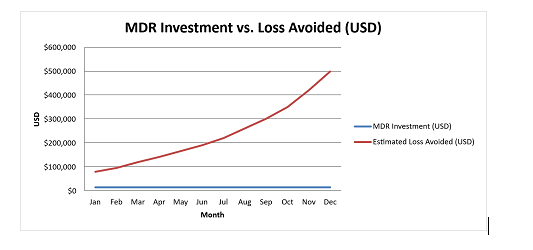
| Axelris Technologies MDR ROI Analysis (12-Month) | ||||
| Month | MDR Investment (USD) | Estimated Loss Avoided (USD) | Net Benefit (USD) | ROI Multiple (x) |
|---|---|---|---|---|
| Jan | $12,900 | $80,000 | $67,100 | 6.2x |
| Feb | $12,900 | $95,000 | $82,100 | 7.4x |
| Mar | $12,900 | $120,000 | $107,100 | 9.3x |
| Apr | $12,900 | $140,000 | $127,100 | 10.9x |
| May | $12,900 | $165,000 | $152,100 | 12.8x |
| Jun | $12,900 | $190,000 | $177,100 | 14.7x |
| Jul | $12,900 | $220,000 | $207,100 | 17.1x |
| Aug | $12,900 | $260,000 | $247,100 | 20.2x |
| Sep | $12,900 | $300,000 | $287,100 | 23.3x |
| Oct | $12,900 | $350,000 | $337,100 | 27.1x |
| Nov | $12,900 | $420,000 | $407,100 | 32.6x |
| Dec | $12,900 | $500,000 | $487,100 | 38.8x |
| TOTAL / AVG | $154,800 | $2,840,000 | $2,685,200 | 18.3x |
| One-time deployment cost (not included in monthly figures above): ROI | $33,000 | |||
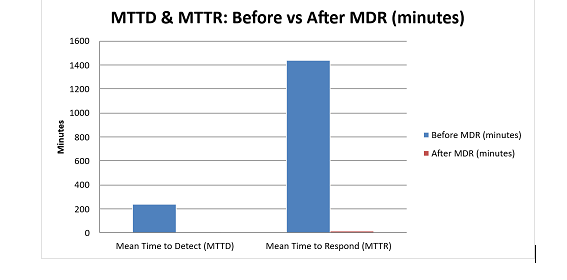
| Mean Time to Detect (MTTD) and Mean Time to Respond (MTTR) | ||
| Metric | Before MDR (minutes) | After MDR (minutes) |
|---|---|---|
| Mean Time to Detect (MTTD) | 240 | 4 |
| Mean Time to Respond (MTTR) | 1440 | 12 |
| % Improvement | 98.3% | 99.2% |
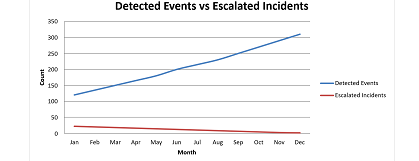
| Incident Profile Detection, Containment and Escalation Trend | |||
| Month | Detected Events | Containment Rate | Escalated Incidents |
|---|---|---|---|
| Jan | 120 | 98.1% | 22 |
| Feb | 135 | 98.2% | 20 |
| Mar | 150 | 98.3% | 18 |
| Apr | 165 | 98.4% | 16 |
| May | 180 | 98.5% | 14 |
| Jun | 200 | 98.6% | 12 |
| Jul | 215 | 98.7% | 10 |
| Aug | 230 | 98.8% | 8 |
| Sep | 250 | 98.9% | 6 |
| Oct | 270 | 99.0% | 4 |
| Nov | 290 | 99.2% | 2 |
| Dec | 310 | 99.5% | 1 |
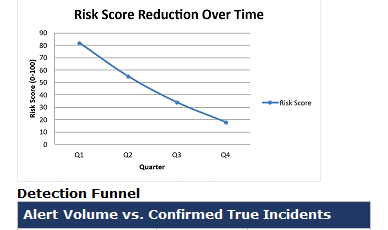
| Organizational Risk Score Trend (Quarterly) | |
| Quarter | Risk Score |
|---|---|
| Q1 | 82 |
| Q2 | 55 |
| Q3 | 34 |
| Q4 | 18 |
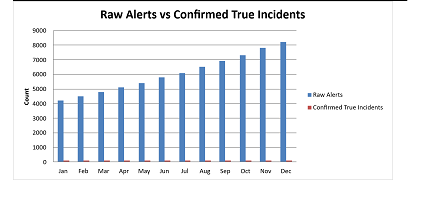
| Alert Volume vs. Confirmed True Incidents | ||
| Month | Raw Alerts | Confirmed True Incidents |
|---|---|---|
| Jan | 4200 | 95 |
| Feb | 4500 | 98 |
| Mar | 4800 | 102 |
| Apr | 5100 | 105 |
| May | 5400 | 108 |
| Jun | 5800 | 110 |
| Jul | 6100 | 112 |
| Aug | 6500 | 113 |
| Sep | 6900 | 114 |
| Oct | 7300 | 115 |
| Nov | 7800 | 116 |
| Dec | 8200 | 117 |
| Avg Noise Reduction % | 98.2% | |
| Tier Component | Fixed Cost (one-time USD) | Fixed Cost (monthly, USD) | Per-Asset Deployment (USD, one-time) | Per-Asset Monitoring (USD/month) |
|---|---|---|---|---|
| Tier 1 Maintenance and Monitoring |
$2,500 | $1,200 | $20 | $6 |
| Tier 2 Hardening and Testing: Vuln scanning + quarterly VAPT reporting |
$1,500 | $1,000 | $8 | $3 |
| Tier 3 Managed SecOps |
$15,000 | $6,000 | $45 | $18 |
| Tier | Deployment Cost (one-time, USD) | Monthly Monitoring Cost (USD) | Annual Monitoring Cost (USD) | Total Year 1 Cost (USD) |
|---|---|---|---|---|
| Tier 1 Maintenance and Monitoring |
$4,500 | $1,800 | $21,600 | $26,100 |
| Tier 2 Hardening and Testing (incl. Tier 1) |
$6,800 | $3,100 | $37,200 | $44,000 |
| Tier 3 Managed SecOps (incl. Tier 1 and 2) |
$26,300 | $10,900 | $130,800 | $157,100 |
Call to Action
Can I set up a quick 15 min. call this week to walk you through which tier makes the most sense for your organization?
© 2026 Axelris Technologies, Inc. All rights reserved.