
The AI Advantage: How Organizations Can Create Competitive Advantage
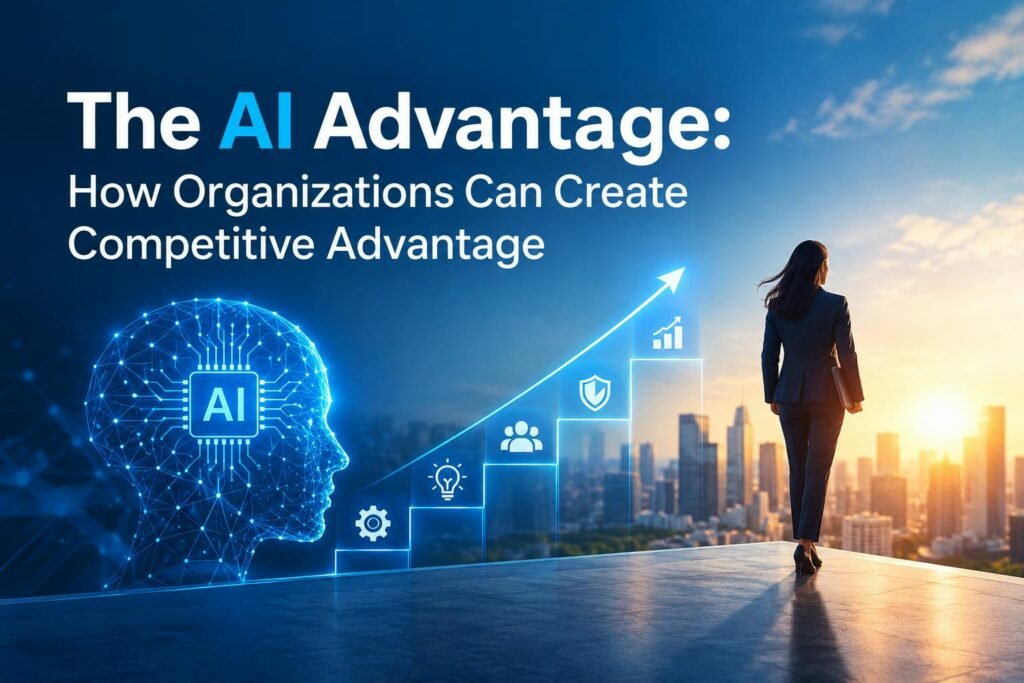
AI is creating new opportunities for businesses to compete, innovate, and grow. It is no longer limited to simple automation or isolated experiments. AI now helps organizations make better decisions, serve customers, protect information, and develop new products. In 2026, the AI advantage comes from turning this technology into measurable business value. Organizations need a clear strategy that connects AI to real goals, protects sensitive information, and empowers employees. Those that take a thoughtful approach can move faster, manage risks, and build a lasting competitive edge.
What Is the AI Advantage?
The AI advantage is the edge a business gains by using artificial intelligence better than its competitors. It can help companies reduce costs, deliver faster service, improve forecasts, strengthen security, and provide better customer experiences.
AI creates value by finding patterns in large amounts of information and helping people act on those patterns. It can summarize documents, detect unusual activity, forecast demand, recommend next steps, and support routine decisions.
However, AI delivers the best results when combined with human expertise. People define goals, review results, and use their judgment to make informed decisions.
Examples appear across many industries.
⦁ A retailer may use AI to recommend products and predict stock needs.
⦁ A manufacturer may use it to identify equipment problems before downtime occurs.
⦁ A financial services firm may use it to detect unusual transactions.
⦁ A healthcare organization may use it to organize information and support clinical workflows.
⦁ In cybersecurity, AI can help teams spot suspicious behavior, prioritize alerts, and respond to threats sooner.
For Axelris, the AI advantage is closely linked to proactive cybersecurity. The company describes its work as combining intelligent technology, continuous protection, and human expertise to reduce cyber risk, detect threats earlier, and respond faster. The same principle applies to AI adoption across the wider business: intelligence is most valuable when it drives timely, well-informed action.
Why AI Is Becoming a Competitive Necessity
AI is becoming a competitive necessity because business decisions now depend on speed, scale, and reliable information. Customers expect quick answers. Employees need easy access to knowledge. Leaders must respond to risks before they become costly problems.
⦁ Faster decision-making. AI can analyze large amounts of data quickly. It helps businesses identify trends, compare options, and spot potential risks. While human judgment remains important, AI gives leaders useful insights to make better-informed decisions.
⦁ Greater operational efficiency. Many organizations still spend time on repetitive work, such as data entry, document searches, report preparation, and routine customer questions. AI can handle these tasks, letting employees focus on work that requires judgment, creativity, and empathy.
⦁ Better customer experiences. AI can help organizations understand customer needs and provide more relevant support. When the experience is faster and more useful, customers have a stronger reason to stay.
These benefits are not automatic. They depend on good data, suitable tools, safe implementation, and employees who can use AI effectively. The OECD AI Principles also stress that AI should be innovative and trustworthy while respecting human rights, privacy, fairness, transparency, and accountability.
Five Ways AI Creates Competitive Advantage
AI creates competitive advantage when it improves how an organization operates, makes decisions, serves customers, innovates, and protects what makes it different. The following five areas offer a practical starting point for business leaders.
- Improve Operational Efficiency
Many organizations lose time to repetitive tasks. Employees may copy information between systems, review routine documents, answer the same questions, or search through large data sets. AI can automate parts of these workflows while keeping people involved where judgment matters.
The result can be lower processing costs, fewer manual errors, and more productive teams. Automation also creates more consistent processes. For example, an AI assistant can classify support requests, summarize documents, or route work to the right department. Employees can then spend more time solving complex problems and serving customers.
The best efficiency projects begin with a clear process. Measure how long the work takes today. Identify common errors. Then test whether AI can improve speed without reducing quality. - Make Better Business Decisions
Good decisions depend on good information. AI can review data from many sources and identify patterns that are difficult to see manually. It can help leaders compare scenarios, detect changes, and explore potential risks.
AI should support decision-makers, not replace accountability. A useful system can highlight an unusual trend or suggest a forecast. A knowledgeable person must still ask whether the data is reliable, the recommendation makes sense, and the decision fits the organization’s values.
When used this way, AI can make planning more informed. It can help teams move from reacting to events toward preparing for likely outcomes. - Deliver More Personalized Customer Experiences
Customers value businesses that understand their needs. AI can help organizations use customer information to make interactions more relevant. Examples include tailored recommendations, faster service responses, helpful search results, and proactive support.
Personalization must be transparent and respectful. Customers should understand how their information is used. Organizations should protect sensitive data and avoid making assumptions that may lead to unfair treatment.
When personalization is built on permission, accuracy, and genuine value, it can improve satisfaction and encourage long-term loyalty. - Accelerate Innovation and Growth
AI helps businesses turn ideas into practical solutions faster. Teams can use it to explore market needs, analyze research, create early prototypes, and compare possible solutions. This makes it easier to learn before investing heavily.
AI can also reveal new opportunities. A company may find an underserved customer group, identify a service gap, or discover a better way to use its existing knowledge.
The key is to use AI for practical experimentation. Start with small tests, measure the results, and use what you learn to guide future investments. - Build Unique Business Capabilities
The most durable advantage comes from capabilities that are difficult to copy. Many organizations have access to generic AI tools. Proprietary data, industry knowledge, trusted processes, and experienced employees are harder to replicate.
Organizations can combine these assets to develop AI solutions for specific business needs. For example, a cybersecurity provider may connect threat intelligence, customer context, and expert analysis to improve detection and response.
The advantage does not come from the AI model alone. It comes from the entire system surrounding it. Organizations that develop these unique capabilities can create more lasting value than those that simply adopt widely available tools.
How to Turn AI Adoption Into Business Value
Successful AI adoption begins with a clear business goal. Organizations should not invest in AI simply because competitors are doing so. Instead, they should focus on problems where AI can deliver real and measurable benefits.
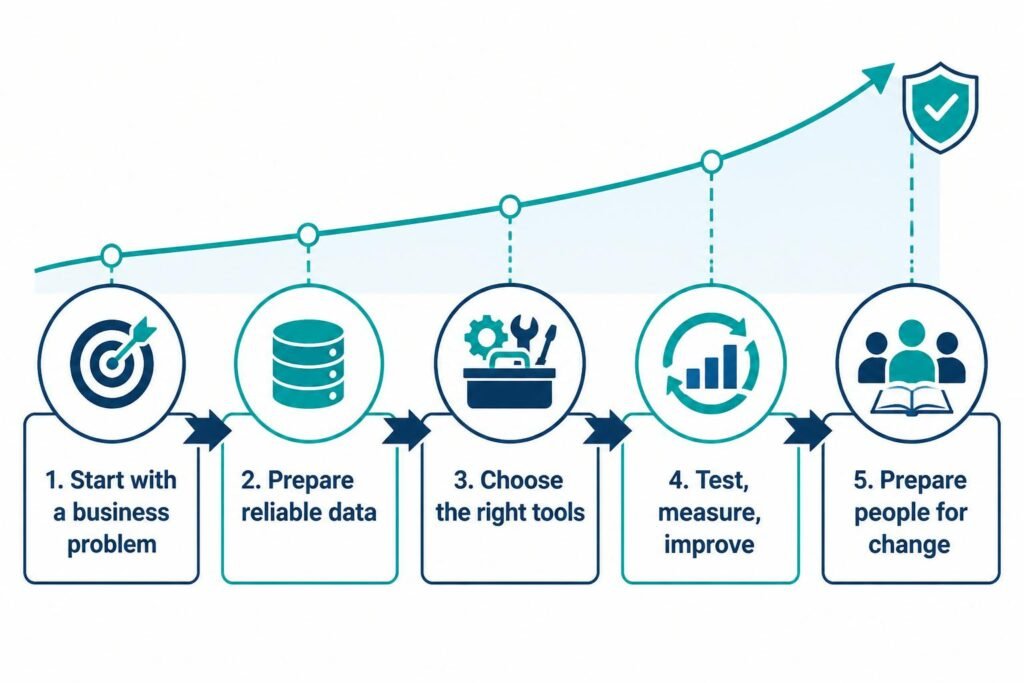
A practical approach includes five steps:
⦁ Step 1: Identify a business problem. Start with a specific need, such as faster response times, better threat detection, or less manual work.
⦁ Step 2: Prepare reliable data. Define ownership, quality standards, access controls, and retention rules before building the solution.
⦁ Step 3: Choose the right tools. Match the technology to the problem. A small automation may be better than a complex platform.
⦁ Step 4: Test, measure, and improve. Run a controlled pilot. Compare results with a baseline. Track both business outcomes and AI quality.
⦁ Step 5: Prepare people for change. Train teams, gather feedback, and explain how AI may affect their roles. Successful AI adoption requires people and processes to adapt to new technology.
Key Challenges Organizations Must Manage
AI creates risks and opportunities. Organizations must manage data privacy and security, especially when sensitive information moves through external services. They must test accuracy and look for harmful bias. They must also address skills gaps, integration work, implementation costs, and employee concerns.
Governance is essential. The NIST AI Risk management Framework identifies trustworthy AI characteristics, including validity and reliability, safety, security, and resilience; accountability and transparency; explainability; privacy enhancement; and fairness, with harmful bias managed. These principles help organizations decide what to test, who approves a system, how performance is monitored, and what happens when an AI system makes a mistake.
How to Measure the AI Advantage
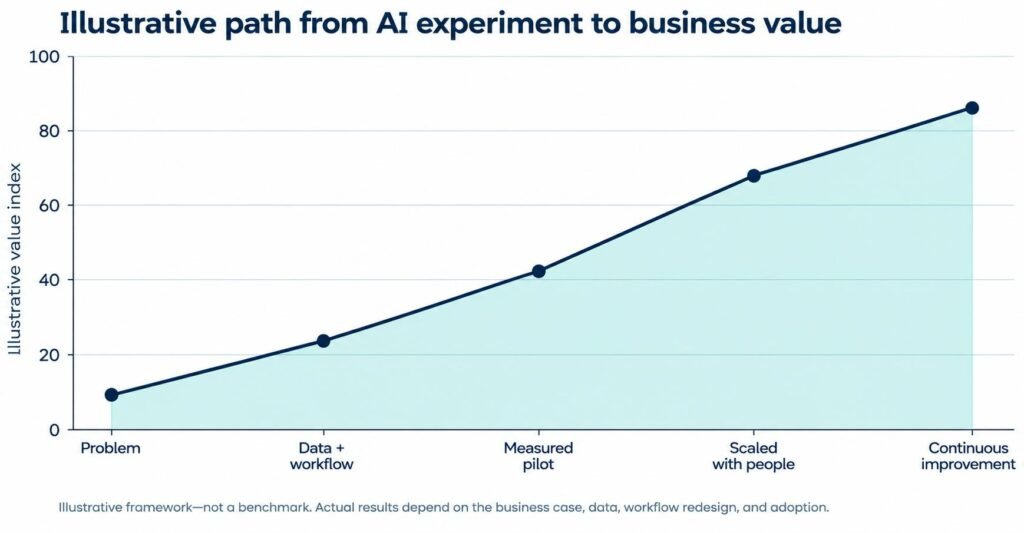
AI success should be measured by its impact on business performance, not just the number of tools an organization deploys or the hours it saves. This includes sales growth and long-term value. Currently, about 6% of firms are considered “AI high performers,” seeing significant EBIT impact from their use of the technology.
Before launching an AI project, define what success looks like. Establish a baseline, set realistic targets, and review the results regularly.
| Business Goal | AI Performance Metrics |
|---|---|
| Efficiency | Time savings, lower error rates, cost per task |
| Growth | Sales growth, conversion rates, customer value |
| Satisfaction | Loyalty scores, retention, faster response |
| Innovation | New product speed, R&D success rate |
| Risk | Detection speed, security incidents, compliance |
Organizations should also consider the total cost of ownership. This includes software, infrastructure, training, integration, maintenance, and human oversight.
Some businesses may see quick improvements in routine tasks. Others may need more time to realize value from complex projects. The important thing is to measure actual outcomes rather than rely on assumptions about what AI should deliver.
Over time, these measurements help leaders decide which initiatives to expand, improve, or stop.
The Role of Leadership in Creating an AI Advantage
Strong leadership turns AI experiments into measurable business results. Leaders should connect every AI project to clear business goals and help employees understand its value. They should also encourage teams to test new ideas, learn from results, and improve their approach.
Building employee skills is equally important. Teams need to understand how AI works, recognize its limitations, and review its outputs carefully. Leaders must also protect business data and intellectual property. Without proper security and trust, AI can create risks instead of a competitive advantage.
As Ib Knudsen, CEO of Axelris Technologies, explains:
“The competitive advantage of tomorrow will not belong to organizations that simply adopt AI. It will belong to those that learn to think differently with AI, act faster because of it, and protect the intelligence that gives them their advantage.”
Conclusion
AI can create a lasting competitive advantage when organizations connect it to real business outcomes. Organizations should start with clear goals, prepare reliable data, improve workflows, measure results, and help employees adapt. They must also protect privacy, security, and intellectual property from the beginning. For Axelris Technologies, this is the practical meaning of Cybersecurity That Thinks Ahead™: use intelligent technology and human expertise to reduce risk, respond faster, and create room for growth. The goal is not just to adopt AI. It is to use it with purpose, responsibility, and a clear vision for the future.
© 2026 Axelris Technologies International, Inc. All rights reserved.